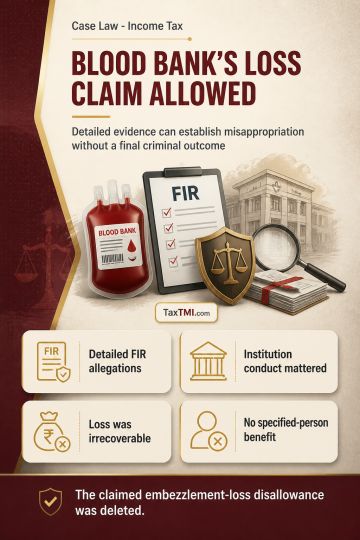
Embezzlement losses in charitable institutions remain allowable when misappropriation is established, irrecoverable, and not a specified-person benefi...
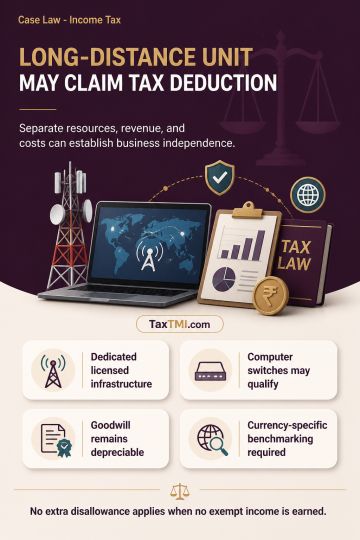
National long-distance undertaking status supports deduction where separately licensed infrastructure, resources, revenue, and expenditure establish c...
Agency reimbursement income follows contractual deposit-liability computation, while pending deposit collections do not constitute deemed-dividend loa...
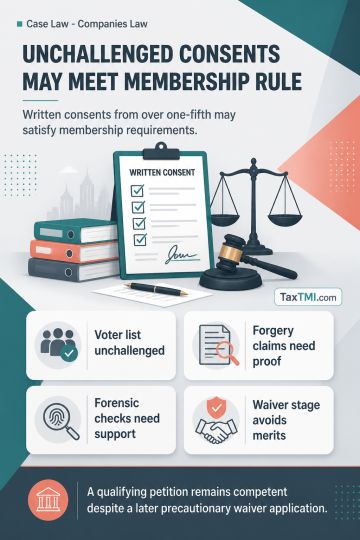
Membership-consent thresholds for oppression petitions are satisfied by unchallenged voter-list consents, while unsupported forgery claims require pro...
The High Court considered a case involving dishonour of cheque due to insufficiency of funds, determining if a legally enforceable debt existed. The accused was acquitted of the offence u/s 138 of the Negotiable Instruments Act. The court assessed evidence to prove cheque execution, rebutting statutory presumptions u/s 139 and 118 of the NI Act. Referring to legal precedents, it highlighted the onus on the accused akin to civil proceedings and the standard of proof required to rebut presumptions. Emphasizing the principle that if two views are possible, an appellate court should not reverse an acquittal. The court upheld the finding that the accused successfully rebutted statutory presumptions, leading to dismissal of the appeal.
The High Court considered a case involving dishonour of cheque due to insufficiency of funds, determining if a legally enforceable debt existed. The accused was acquitted of the offence u/s 138 of the Negotiable Instruments Act. The court assessed evidence to prove cheque execution, rebutting statutory presumptions u/s 139 and 118 of the NI Act. Referring to legal precedents, it highlighted the onus on the accused akin to civil proceedings and the standard of proof required to rebut presumptions. Emphasizing the principle that if two views are possible, an appellate court should not reverse an acquittal. The court upheld the finding that the accused successfully rebutted statutory presumptions, leading to dismissal of the appeal.
Note: It is a system-generated summary and is for quick reference only.
 TaxTMI
  TaxTMI
 of 4881