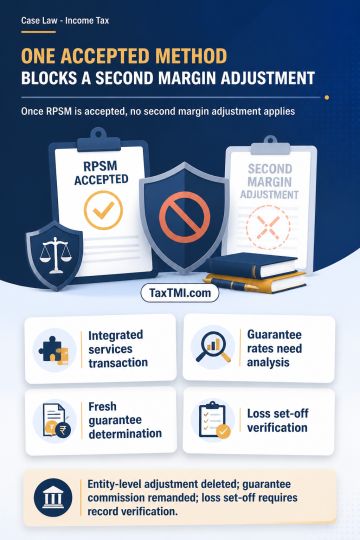
Form 26AS evidence requires successor-entity accounting verification after business transfer, while invoice-supported related-party advertising expend...
Money-laundering judgment timing requires awaiting the scheduled-offence decision despite continuation of the underlying trial where outcomes directly...
Accredited investor eligibility expands through securities-market exposure, while alternative investment fund disputes require prescribed resolution a...
Page of 4916
Press 'Enter' after typing page number.
41 to 60 of 98302 Results
❮
❯
❯❯
0 / 200
Expand Note
Add to Folder
No Folders have been created
+
Are you sure you want to delete "My most important" ?
The Appellate Tribunal considered the validity of a scrutiny assessment conducted by an Additional Commissioner of Income Tax (Addl. CIT) under section 143(3) read with section 144C(13) of the Income Tax Act. It was held that only the Assessing Officer (AO) has the authority to conduct a scrutiny assessment and pass the assessment order. The Addl. CIT can exercise AO's powers only if authorized under section 120(4)(b) of the Act, which was not demonstrated in this case. The Tribunal emphasized that the Revenue must provide evidence of such authorization. The Tribunal also clarified that the time limit for challenging the jurisdiction of the AO does not apply when the action is deemed to be without authority of law. As no separate orders were passed authorizing the Addl. CIT and no jurisdiction transfer order was issued, the assessment order was deemed to be without jurisdiction and was set aside, resulting in the appeal being allowed in favor of the assessee.
The Appellate Tribunal considered the validity of a scrutiny assessment conducted by an Additional Commissioner of Income Tax (Addl. CIT) under section 143(3) read with section 144C(13) of the Income Tax Act. It was held that only the Assessing Officer (AO) has the authority to conduct a scrutiny assessment and pass the assessment order. The Addl. CIT can exercise AO's powers only if authorized under section 120(4)(b) of the Act, which was not demonstrated in this case. The Tribunal emphasized that the Revenue must provide evidence of such authorization. The Tribunal also clarified that the time limit for challenging the jurisdiction of the AO does not apply when the action is deemed to be without authority of law. As no separate orders were passed authorizing the Addl. CIT and no jurisdiction transfer order was issued, the assessment order was deemed to be without jurisdiction and was set aside, resulting in the appeal being allowed in favor of the assessee.
Note: It is a system-generated summary and is for quick reference only.
 TaxTMI
 TaxTMI

 of 4916