Membership-consent thresholds for oppression petitions are satisfied by unchallenged voter-list consents, while unsupported forgery claims require pro...
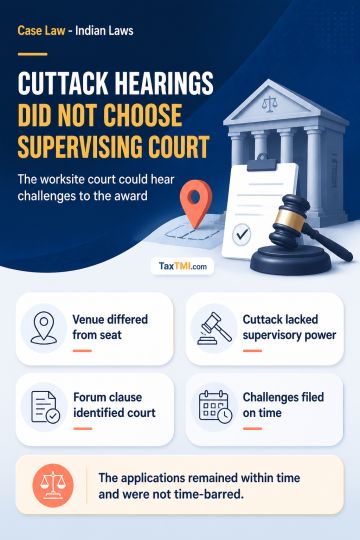
Juridical seat versus arbitral venue determines supervisory court jurisdiction, while timely award challenges remain within the prescribed limitation ...
The Calcutta High Court addressed the nature of a sales tax incentive received under the "West Bengal Incentive Scheme, 2000" for industrial promotion. The scheme aimed at industrializing backward areas by providing incentives. The court held that the subsidy received was a capital receipt, not subject to Section 41(1) of the Income Tax Act, 1961. Referring to a previous case, the court emphasized the capital nature of the subsidy. The appellant failed to differentiate this case from a prior judgment on the same scheme. Consequently, the court ruled in favor of the respondent, affirming the subsidy as a capital receipt.
The Calcutta High Court addressed the nature of a sales tax incentive received under the "West Bengal Incentive Scheme, 2000" for industrial promotion. The scheme aimed at industrializing backward areas by providing incentives. The court held that the subsidy received was a capital receipt, not subject to Section 41(1) of the Income Tax Act, 1961. Referring to a previous case, the court emphasized the capital nature of the subsidy. The appellant failed to differentiate this case from a prior judgment on the same scheme. Consequently, the court ruled in favor of the respondent, affirming the subsidy as a capital receipt.
Note: It is a system-generated summary and is for quick reference only.
 TaxTMI
  TaxTMI
 of 4894