Capital-gains exemption for charitable trusts extends to qualifying fixed deposits, while unrecoverable TDS write-offs may constitute income applicati...
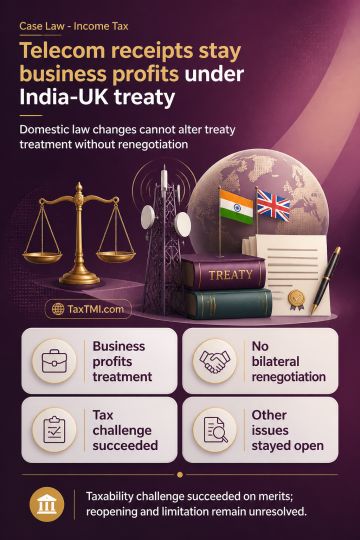
India-UK treaty characterisation of telecom-service receipts as business profits withstands unilateral domestic-law amendments for Indian tax purposes...
Page of 4905
Press 'Enter' after typing page number.
741 to 760 of 98083 Results
❮
❯
❯❯
0 / 200
Expand Note
Add to Folder
No Folders have been created
+
Are you sure you want to delete "My most important" ?
The case involved a dispute regarding the applicability of service tax on corporate guarantee fees u/s 65(12)(a)(ix) of the Finance Act. The tribunal held that providing a corporate guarantee does not constitute Banking and Other Financial Services (BOFS) and is not related to lending activity. Citing precedents, the tribunal concluded that the corporate guarantee does not fall within the ambit of lending activity. The demand for service tax u/s reverse charge mechanism prior to 01.07.2012 was set aside as corporate guarantee does not qualify as BOFS. For the period post 01.07.2012, since the appellant had already paid the tax liability, it cannot be demanded again. The tribunal also found that the invocation of the extended period was unjustified as there was no evidence of mala fide intention to evade payment. Consequently, the demand for the period from 2009-2010 to 1st July 2012 was set aside, and the appeal was allowed.
The case involved a dispute regarding the applicability of service tax on corporate guarantee fees u/s 65(12)(a)(ix) of the Finance Act. The tribunal held that providing a corporate guarantee does not constitute Banking and Other Financial Services (BOFS) and is not related to lending activity. Citing precedents, the tribunal concluded that the corporate guarantee does not fall within the ambit of lending activity. The demand for service tax u/s reverse charge mechanism prior to 01.07.2012 was set aside as corporate guarantee does not qualify as BOFS. For the period post 01.07.2012, since the appellant had already paid the tax liability, it cannot be demanded again. The tribunal also found that the invocation of the extended period was unjustified as there was no evidence of mala fide intention to evade payment. Consequently, the demand for the period from 2009-2010 to 1st July 2012 was set aside, and the appeal was allowed.
Note: It is a system-generated summary and is for quick reference only.
 TaxTMI
  TaxTMI
 of 4905