Political contribution deductions require genuine transactions; banking records and party registration alone cannot defeat evidence of accommodation e...
Post-death GST liability permits fresh proceedings against legal representatives, while discontinued-business recovery remains limited to the inherite...
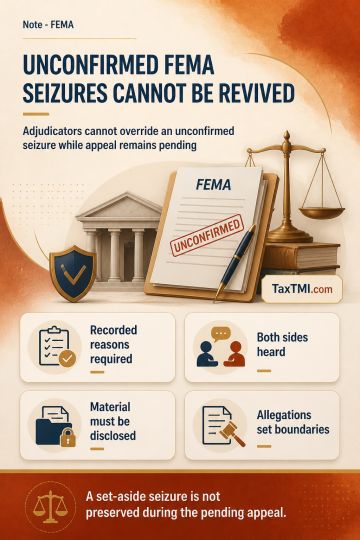
Non-confirmation of FEMA seizure prevents adjudicators from overriding pending appellate findings on recorded reasons and suspected foreign asset hold...
Penalty u/s 271 (1) (c) - Income disclosed only after the search and seizure operation - The High Court emphasized that Explanation 5A of Section 271(1)(c) deems concealed income even if disclosed post-search, and upheld the assessing officer’s initiation of penalty proceedings based on detailed findings of concealed income in the assessment orders. The Court referenced key Supreme Court judgments, asserting that the satisfaction for penalty can be inferred from the assessment order and need not be explicitly stated in the notice if the order details the concealment. It also rejected the respondent’s defense of voluntary disclosure, noting it was made only after irrefutable evidence of concealment emerged during the search. It set aside the ITAT’s order, reinstated the penalties, and remanded the matter to the ITAT for adjudication on merits.
Penalty u/s 271 (1) (c) - Income disclosed only after the search and seizure operation - The High Court emphasized that Explanation 5A of Section 271(1)(c) deems concealed income even if disclosed post-search, and upheld the assessing officer’s initiation of penalty proceedings based on detailed findings of concealed income in the assessment orders. The Court referenced key Supreme Court judgments, asserting that the satisfaction for penalty can be inferred from the assessment order and need not be explicitly stated in the notice if the order details the concealment. It also rejected the respondent’s defense of voluntary disclosure, noting it was made only after irrefutable evidence of concealment emerged during the search. It set aside the ITAT’s order, reinstated the penalties, and remanded the matter to the ITAT for adjudication on merits.
Note: It is a system-generated summary and is for quick reference only.
 TaxTMI
  TaxTMI
 of 4918