GST refunds for cancelled air tickets remain available when passenger reimbursements defeat unjust enrichment and credit-note adjustment is unavailabl...
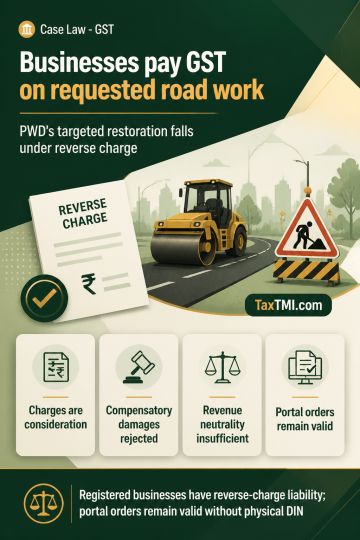
Request-driven road restoration attracts reverse-charge GST, not governmental-function treatment or compensatory-damages status for business recipient...
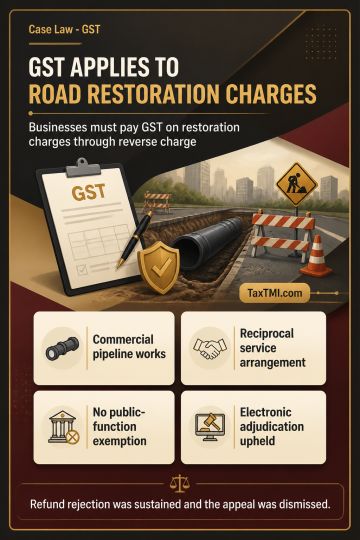
Road restoration charges for commercial pipeline works are taxable Government services, with reverse charge liability and no public-function exemption...
Blocking the input tax credit against the petitioners - The High Court emphasizes that Rule 86(A) allows restricting debit from the electronic credit ledger for an amount equivalent to fraudulently availed credit. Rule 86(A) doesn't authorize negative balance insertion in the ledger; it only permits blocking of the credit available. The Court rules that blocking ITC effectively deprives the petitioner of the right to discharge liabilities. The respondents should have initiated recovery proceedings under Section 73 or Section 74 if the petitioner had fraudulently availed ITC. The action of the respondents is deemed unsustainable as it violates Rule 86(A) and previous court decisions. Consequently, the impugned order is set aside, and the respondents are directed to recall the order of blockage immediately.
Blocking the input tax credit against the petitioners - The High Court emphasizes that Rule 86(A) allows restricting debit from the electronic credit ledger for an amount equivalent to fraudulently availed credit. Rule 86(A) doesn't authorize negative balance insertion in the ledger; it only permits blocking of the credit available. The Court rules that blocking ITC effectively deprives the petitioner of the right to discharge liabilities. The respondents should have initiated recovery proceedings under Section 73 or Section 74 if the petitioner had fraudulently availed ITC. The action of the respondents is deemed unsustainable as it violates Rule 86(A) and previous court decisions. Consequently, the impugned order is set aside, and the respondents are directed to recall the order of blockage immediately.
Note: It is a system-generated summary and is for quick reference only.
 TaxTMI
  TaxTMI
 of 4918