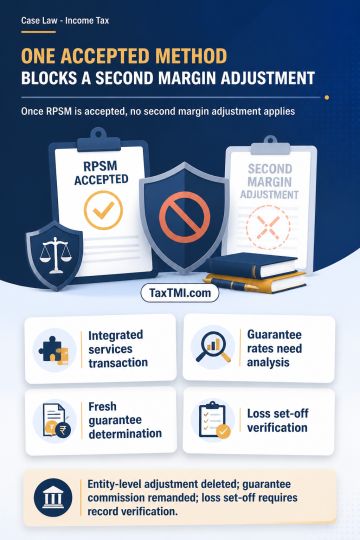
Form 26AS evidence requires successor-entity accounting verification after business transfer, while invoice-supported related-party advertising expend...
Money-laundering judgment timing requires awaiting the scheduled-offence decision despite continuation of the underlying trial where outcomes directly...
Accredited investor eligibility expands through securities-market exposure, while alternative investment fund disputes require prescribed resolution a...
Page of 4916
Press 'Enter' after typing page number.
41 to 60 of 98302 Results
❮
❯
❯❯
0 / 200
Expand Note
Add to Folder
No Folders have been created
+
Are you sure you want to delete "My most important" ?
Classification of Goods - Imports goods in the nature of e-rickshaw in CKD condition - The Tribunal examines the essential components of the imported goods and determines that they do not constitute fully finished e-rickshaws. Despite having essential parts, the goods lack a battery, crucial for propulsion. Therefore, the Tribunal upholds the classification of the goods as spare parts of electric tricycles rather than complete e-rickshaws. - The Tribunal scrutinizes the interpretation of Rule 2(a) of General Rules for the Interpretation of the Harmonized System (GIR) and concludes that the lower authority's reliance on it was flawed. It emphasizes that statutory interpretation should align with the Customs Tariff Act and be purposive rather than strictly literal.
Classification of Goods - Imports goods in the nature of e-rickshaw in CKD condition - The Tribunal examines the essential components of the imported goods and determines that they do not constitute fully finished e-rickshaws. Despite having essential parts, the goods lack a battery, crucial for propulsion. Therefore, the Tribunal upholds the classification of the goods as spare parts of electric tricycles rather than complete e-rickshaws. - The Tribunal scrutinizes the interpretation of Rule 2(a) of General Rules for the Interpretation of the Harmonized System (GIR) and concludes that the lower authority's reliance on it was flawed. It emphasizes that statutory interpretation should align with the Customs Tariff Act and be purposive rather than strictly literal.
Note: It is a system-generated summary and is for quick reference only.
 TaxTMI
 TaxTMI

 of 4916