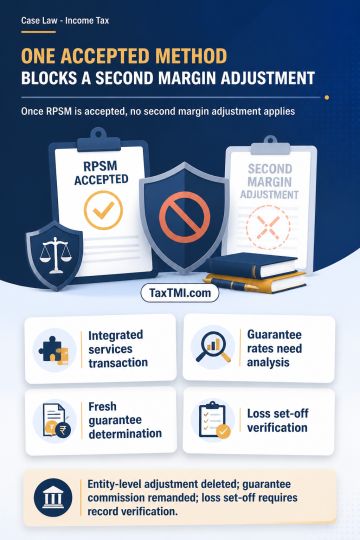
Form 26AS evidence requires successor-entity accounting verification after business transfer, while invoice-supported related-party advertising expend...
Money-laundering judgment timing requires awaiting the scheduled-offence decision despite continuation of the underlying trial where outcomes directly...
Accredited investor eligibility expands through securities-market exposure, while alternative investment fund disputes require prescribed resolution a...
Page of 4916
Press 'Enter' after typing page number.
41 to 60 of 98302 Results
❮
❯
❯❯
0 / 200
Expand Note
Add to Folder
No Folders have been created
+
Are you sure you want to delete "My most important" ?
Denial of Foreign Tax Credit (FTC) - being Form 67 was not filed along with the ITR before the time limit u/s 139 (1) - The use of the word "shall" in the rule indicates the mandatory nature of this requirement. - The Tribunal referred to a precedent set by the Mumbai Bench of the ITAT in the case of Rohini Hattangadi vs. CIT (A), where it was held that the delay in filing Form 67 should not disentitle the assessee from claiming FTC. The decision emphasized that procedural law should not be construed as mandatory if it aids the claim of substantive right. - Furthermore, the Tribunal considered various decisions stating that provisions of Double Taxation Avoidance Agreements (DTAA) override the provisions of the Act if they are beneficial to the assessee.
Denial of Foreign Tax Credit (FTC) - being Form 67 was not filed along with the ITR before the time limit u/s 139 (1) - The use of the word "shall" in the rule indicates the mandatory nature of this requirement. - The Tribunal referred to a precedent set by the Mumbai Bench of the ITAT in the case of Rohini Hattangadi vs. CIT (A), where it was held that the delay in filing Form 67 should not disentitle the assessee from claiming FTC. The decision emphasized that procedural law should not be construed as mandatory if it aids the claim of substantive right. - Furthermore, the Tribunal considered various decisions stating that provisions of Double Taxation Avoidance Agreements (DTAA) override the provisions of the Act if they are beneficial to the assessee.
Note: It is a system-generated summary and is for quick reference only.
 TaxTMI
 TaxTMI

 of 4916