Pre-amendment reassessment limitation bars late notices under the preserved regime, invalidating consequential reassessment for affected earlier asses...
Cash-sales explanations for bank deposits require documentary reconciliation; reassessment notice survived where effective response time was available...
Functional comparability in transfer pricing prevents ad hoc arm's length adjustments where functions, assets, risks and reliable comparables are unes...
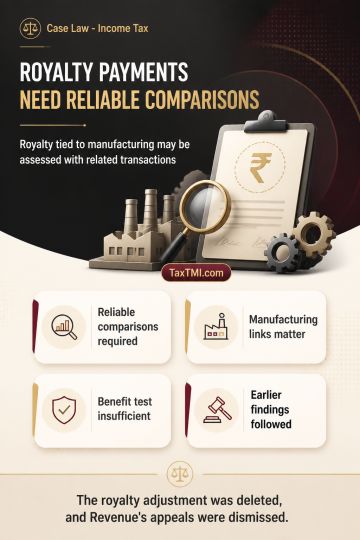
Contingency expenses, exempt-income disallowance, and royalty benchmarking: unsupported adjustments were deleted under consistent accounting and trans...
Page of 4920
Press 'Enter' after typing page number.
61 to 80 of 98394 Results
❮
❯
❯❯
0 / 200
Expand Note
Add to Folder
No Folders have been created
+
Are you sure you want to delete "My most important" ?
Taxability of Income in India - international taxation, permanent establishment (PE), and treaty benefits under the India-UK Double Taxation Avoidance Agreement (DTAA). - The ITAT upheld this contention of the assessee, emphasizing that possession of a valid Tax Residency Certificate indeed qualifies the entity as a resident of the UK for tax purposes, thereby entitling it to treaty benefits under the India-UK DTAA. - Further, the ITAT concluded that the Indian company acted independently, without the authority to conclude contracts on behalf of the appellant. Hence, it was determined that there was no Fixed Place PE or Dependent Agent PE in India for the appellant. - The ITAT disagreed with the lower authorities' attribution of profits to a presumed PE in India. It clarified that the appellant's business activities, particularly related to offshore supplies, did not constitute a business connection in India.
Taxability of Income in India - international taxation, permanent establishment (PE), and treaty benefits under the India-UK Double Taxation Avoidance Agreement (DTAA). - The ITAT upheld this contention of the assessee, emphasizing that possession of a valid Tax Residency Certificate indeed qualifies the entity as a resident of the UK for tax purposes, thereby entitling it to treaty benefits under the India-UK DTAA. - Further, the ITAT concluded that the Indian company acted independently, without the authority to conclude contracts on behalf of the appellant. Hence, it was determined that there was no Fixed Place PE or Dependent Agent PE in India for the appellant. - The ITAT disagreed with the lower authorities' attribution of profits to a presumed PE in India. It clarified that the appellant's business activities, particularly related to offshore supplies, did not constitute a business connection in India.
Note: It is a system-generated summary and is for quick reference only.
 TaxTMI
 TaxTMI

 of 4920