Explained Investment Sources: documented gifts and traceable salary savings supported deletion of additions for property and mutual-fund SIP investmen...
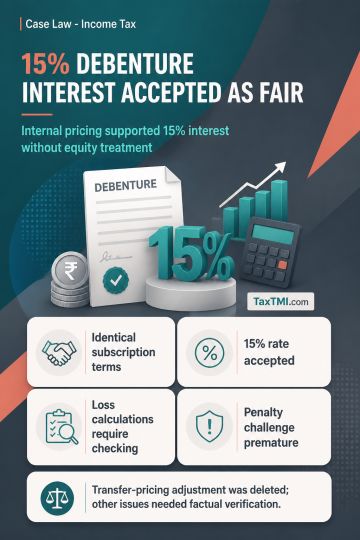
Internal comparable pricing supports arm's-length interest on compulsorily convertible debentures, preventing their recharacterisation as equity for t...
Nominee director protection shields independent financial-institution appointees from criminal liability where they lack involvement in deposit defaul...
The High Court dismissed the petitions seeking to quash the criminal complaint under the Prevention of Money-Laundering Act, 2002 (PMLA). The petitioners argued that the complaint lacked sufficient grounds, as the predicate offense initiated by the CBI was pending, and there was no evidence linking the funds used for property purchase to proceeds of crime. However, the court upheld the constitutionality and interpretation of the PMLA as clarified by the Supreme Court in Vijay Madanlal Choudhary case. It emphasized that money laundering is a continuous process, and prosecution under the PMLA can be initiated independently of the status of the scheduled offense.
The High Court dismissed the petitions seeking to quash the criminal complaint under the Prevention of Money-Laundering Act, 2002 (PMLA). The petitioners argued that the complaint lacked sufficient grounds, as the predicate offense initiated by the CBI was pending, and there was no evidence linking the funds used for property purchase to proceeds of crime. However, the court upheld the constitutionality and interpretation of the PMLA as clarified by the Supreme Court in Vijay Madanlal Choudhary case. It emphasized that money laundering is a continuous process, and prosecution under the PMLA can be initiated independently of the status of the scheduled offense.
Note: It is a system-generated summary and is for quick reference only.
 TaxTMI
  TaxTMI
 of 4886