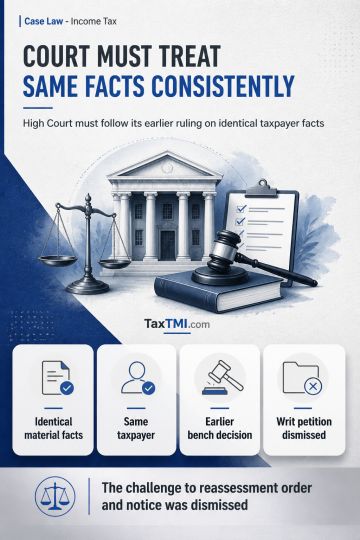
Judicial discipline requires consistent reassessment treatment where identical facts were decided for the same taxpayer in the preceding assessment ye...
Appellant is a juridical person or not - Appellant can be treated as a “trust” or not - service provided to contributories or not - The High Court found that the assessee acts as a ‘pass through’, wherein funds from contributors are consolidated and invested by the investment manager. It acts as a trustee holding the money belonging to contributors to be invested as per the advice of the investment manager - The HC further held that, It is not in dispute that contributors are institutional investors. It is noted that doctrine of mutuality applies when commonality is established between the contributors and participators - In the instant case, the contributors and the trust cannot be dissected as two different entities. - Applying the doctrine of mutuality, demand of service tax set aside.
Appellant is a juridical person or not - Appellant can be treated as a “trust” or not - service provided to contributories or not - The High Court found that the assessee acts as a ‘pass through’, wherein funds from contributors are consolidated and invested by the investment manager. It acts as a trustee holding the money belonging to contributors to be invested as per the advice of the investment manager - The HC further held that, It is not in dispute that contributors are institutional investors. It is noted that doctrine of mutuality applies when commonality is established between the contributors and participators - In the instant case, the contributors and the trust cannot be dissected as two different entities. - Applying the doctrine of mutuality, demand of service tax set aside.
Note: It is a system-generated summary and is for quick reference only.
 TaxTMI
  TaxTMI
 of 4888