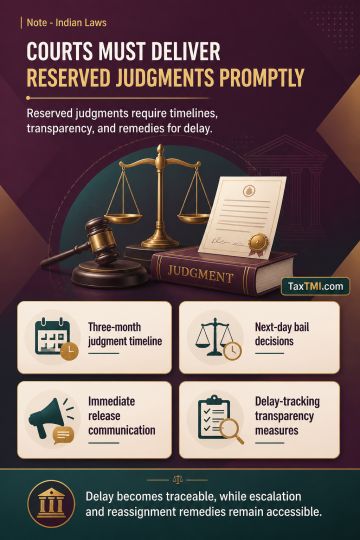
Timely pronouncement of reserved judgments requires defined timelines, transparency measures, and remedial pathways to protect liberty and effective j...
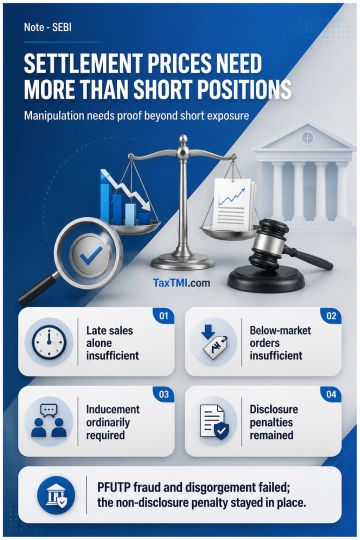
Settlement-price depression requires proof of manipulation, not merely short exposure, late selling, or below-market orders, preserving disclosure pen...
Income Declaration Scheme declarations can evidence share-capital sources, while round-tripped funds and cash-linked credits require further verificat...
Forfeiture of the earnest money deposit by the appellant bank - The Supreme Court held that, the underlying principle envisaged u/s(s) 73 & 74 of the Indian Contract Act, 1872 which is a general law will have no application, when it comes to the SARFAESI Act more particularly the forfeiture of earnest-money deposit which has been statutorily provided under Rule 9(5) of the SARFAESI Rules as a consequence of the auction purchaser’s failure to deposit the balance amount. - The High Court erred in law by holding that forfeiture of the entire deposit under Rule 9 sub-rule (5) of the SARFAESI Rules by the appellant bank after having already recovered its dues from the subsequent sale amounts to unjust enrichment.
Forfeiture of the earnest money deposit by the appellant bank - The Supreme Court held that, the underlying principle envisaged u/s(s) 73 & 74 of the Indian Contract Act, 1872 which is a general law will have no application, when it comes to the SARFAESI Act more particularly the forfeiture of earnest-money deposit which has been statutorily provided under Rule 9(5) of the SARFAESI Rules as a consequence of the auction purchaser’s failure to deposit the balance amount. - The High Court erred in law by holding that forfeiture of the entire deposit under Rule 9 sub-rule (5) of the SARFAESI Rules by the appellant bank after having already recovered its dues from the subsequent sale amounts to unjust enrichment.
Note: It is a system-generated summary and is for quick reference only.
 TaxTMI
  TaxTMI