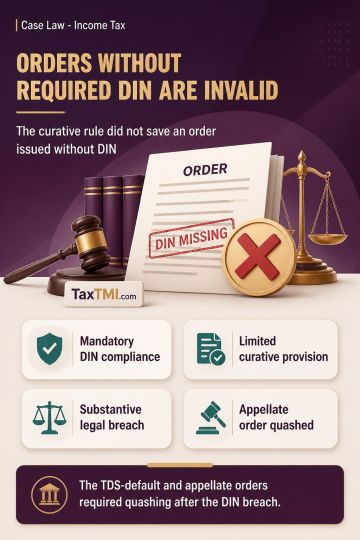
Document Identification Number compliance renders TDS-default orders invalid where mandatory DIN requirements are breached and curative provision does...
Insolvency and BankruptcySeptember 15, 2022Case LawsAT
Initiation of CIRP - The Assignment to Suraksha is not a bona fide one, peculiar to the facts of the attendant case and the loan amounts do not satisfy the essential requisites of a ‘Financial Debt’ as envisaged under the Code. This Tribunal observed that the fundamental scope & objective of IBC is ‘Resolution’ and ‘Maximization of Assets’ and not ‘Recovery’ of loans which do not strictly fall within the definition of ‘Financial Debt’ as defined under Section 5(8) of the Code. - AT
Initiation of CIRP - The Assignment to Suraksha is not a bona fide one, peculiar to the facts of the attendant case and the loan amounts do not satisfy the essential requisites of a ‘Financial Debt’ as envisaged under the Code. This Tribunal observed that the fundamental scope & objective of IBC is ‘Resolution’ and ‘Maximization of Assets’ and not ‘Recovery’ of loans which do not strictly fall within the definition of ‘Financial Debt’ as defined under Section 5(8) of the Code. - AT
Note: It is a system-generated summary and is for quick reference only.
 TaxTMI
  TaxTMI
 of 4918