Capital-gains exemption for charitable trusts extends to qualifying fixed deposits, while unrecoverable TDS write-offs may constitute income applicati...
India-UK treaty characterisation of telecom-service receipts as business profits withstands unilateral domestic-law amendments for Indian tax purposes...
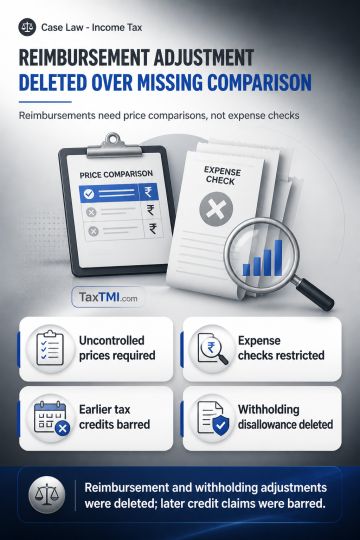
Transfer-pricing reimbursement adjustments require uncontrolled comparables and cannot become expense-genuineness reviews, resulting in deletion of th...
Page of 4881
Press 'Enter' after typing page number.
281 to 300 of 97618 Results
❮
❯
❯❯
0 / 200
Expand Note
Add to Folder
No Folders have been created
+
Are you sure you want to delete "My most important" ?
Power to CIT(A) to set aside the order and remand back to AO - CIT(A) has only directed the AO to determine the actual distance based on these findings and then accordingly deal with the adjustment to be made. There is clearly a difference between setting aside an issue to the A.O., which power the Ld. CIT(A) does not have as per Section 251 of the Act, and giving directions to the AO. An issue set aside to the AO is left for adjudication to him, while in a case giving directions, the issue is restored to the AO only for acting on the adjudication done by the CIT(A). - AT
Power to CIT(A) to set aside the order and remand back to AO - CIT(A) has only directed the AO to determine the actual distance based on these findings and then accordingly deal with the adjustment to be made. There is clearly a difference between setting aside an issue to the A.O., which power the Ld. CIT(A) does not have as per Section 251 of the Act, and giving directions to the AO. An issue set aside to the AO is left for adjudication to him, while in a case giving directions, the issue is restored to the AO only for acting on the adjudication done by the CIT(A). - AT
Note: It is a system-generated summary and is for quick reference only.
 TaxTMI
  TaxTMI
 of 4881