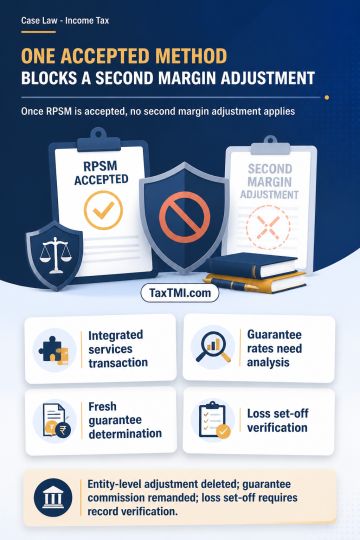
Form 26AS evidence requires successor-entity accounting verification after business transfer, while invoice-supported related-party advertising expend...
Money-laundering judgment timing requires awaiting the scheduled-offence decision despite continuation of the underlying trial where outcomes directly...
Accredited investor eligibility expands through securities-market exposure, while alternative investment fund disputes require prescribed resolution a...
Page of 4916
Press 'Enter' after typing page number.
41 to 60 of 98302 Results
❮
❯
❯❯
0 / 200
Expand Note
Add to Folder
No Folders have been created
+
Are you sure you want to delete "My most important" ?
Assignment of debt to Asset Reconstruction Company - whether Power of Attorney is chargeable to stamp duty or not - In all taxing Statutes, there are taxing provisions and machinery provisions. Once a single instrument has been charged under a correct charging provision of the Statute, namely Article 20(a), the Revenue cannot split the instrument into two, because of the reduction in the stamp duty facilitated by a notification of the Government issued under Section 9(a). In other words after having accepted the deed of assignment as an instrument chargeable to duty as a conveyance under Article 20(a) and after having collected the duty payable on the same, it is not open to the respondent to subject the same instrument to duty once again under Article 45(f), merely because the appellant had the benefit of the notifications under Section 9(a). - SC
Assignment of debt to Asset Reconstruction Company - whether Power of Attorney is chargeable to stamp duty or not - In all taxing Statutes, there are taxing provisions and machinery provisions. Once a single instrument has been charged under a correct charging provision of the Statute, namely Article 20(a), the Revenue cannot split the instrument into two, because of the reduction in the stamp duty facilitated by a notification of the Government issued under Section 9(a). In other words after having accepted the deed of assignment as an instrument chargeable to duty as a conveyance under Article 20(a) and after having collected the duty payable on the same, it is not open to the respondent to subject the same instrument to duty once again under Article 45(f), merely because the appellant had the benefit of the notifications under Section 9(a). - SC
Note: It is a system-generated summary and is for quick reference only.
 TaxTMI
 TaxTMI

 of 4916