GST refunds for cancelled air tickets remain available when passenger reimbursements defeat unjust enrichment and credit-note adjustment is unavailabl...
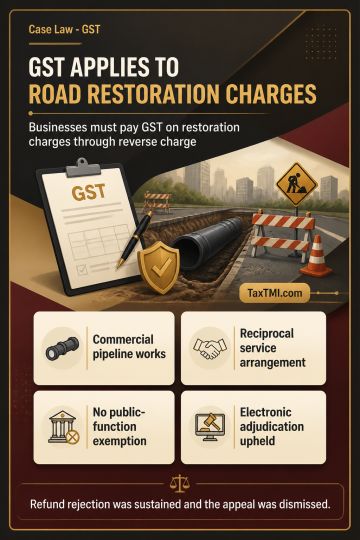
Request-driven road restoration attracts reverse-charge GST, not governmental-function treatment or compensatory-damages status for business recipient...
Road restoration charges for commercial pipeline works are taxable Government services, with reverse charge liability and no public-function exemption...
Dishonor of Cheque - compounding of offences - Even though the parties have arrived at a settlement after the Appellate Court had upheld the conviction of the petitioner, yet keeping in view the spirit of Section 147 of the NI Act, the offence under Section 138 of the Act can be compounded, as the respondent has clearly agreed that on account of precarious financial condition of the petitioner, he is ready to accept the amount of ₹ 25000/- which he has already received from the petitioner and the amount which is deposited with the Registry of this Court as full and final settlement of his claim. Therefore, this is a fit case where costs are required to be waived while compounding the offence. HC
Dishonor of Cheque - compounding of offences - Even though the parties have arrived at a settlement after the Appellate Court had upheld the conviction of the petitioner, yet keeping in view the spirit of Section 147 of the NI Act, the offence under Section 138 of the Act can be compounded, as the respondent has clearly agreed that on account of precarious financial condition of the petitioner, he is ready to accept the amount of ₹ 25000/- which he has already received from the petitioner and the amount which is deposited with the Registry of this Court as full and final settlement of his claim. Therefore, this is a fit case where costs are required to be waived while compounding the offence. HC
Note: It is a system-generated summary and is for quick reference only.
 TaxTMI
  TaxTMI
 of 4918