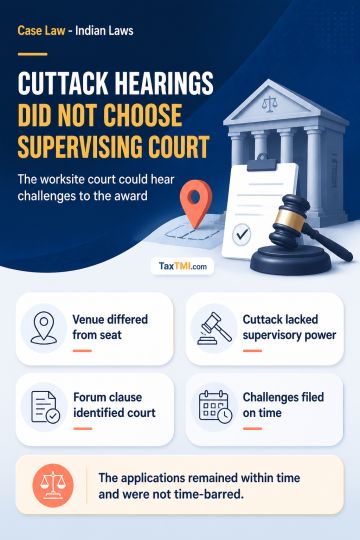
Juridical seat versus arbitral venue determines supervisory court jurisdiction, while timely award challenges remain within the prescribed limitation ...
Once the CoC (Respondent No. 2) has approved the Resolution Plan, the Administrator of the DHFL, has to obtain no-objection from RBI in accordance with Rule 5(d) of the FSP Insolvency Rules. Apart from the same, neither the Code nor the FSP Insolvency Rules, casts any other obligation on RBI vis-à-vis the CIRP process, which is left to be run by the resolution professional along with the CoC as per its commercial wisdom. The RBI cannot intervene in the CIRP process, and the reliefs as sought for by the Applicant qua RBI seeks RBI to intervene in the CIRP process, which is completely contrary and inconsistent with the spirit of the Code and will have the effect of derailing the CIR Process. - Tri
Once the CoC (Respondent No. 2) has approved the Resolution Plan, the Administrator of the DHFL, has to obtain no-objection from RBI in accordance with Rule 5(d) of the FSP Insolvency Rules. Apart from the same, neither the Code nor the FSP Insolvency Rules, casts any other obligation on RBI vis-à-vis the CIRP process, which is left to be run by the resolution professional along with the CoC as per its commercial wisdom. The RBI cannot intervene in the CIRP process, and the reliefs as sought for by the Applicant qua RBI seeks RBI to intervene in the CIRP process, which is completely contrary and inconsistent with the spirit of the Code and will have the effect of derailing the CIR Process. - Tri
Note: It is a system-generated summary and is for quick reference only.
 TaxTMI
  TaxTMI
 of 4881