Timely pronouncement of reserved judgments requires defined timelines, transparency measures, and remedial pathways to protect liberty and effective j...
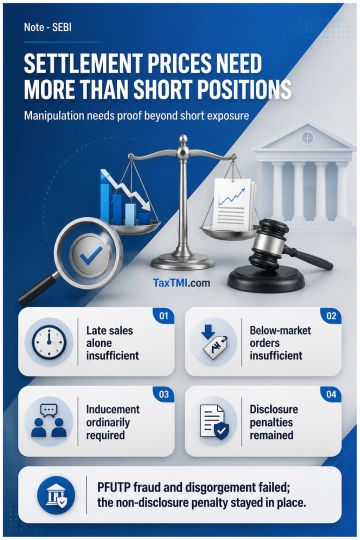
Settlement-price depression requires proof of manipulation, not merely short exposure, late selling, or below-market orders, preserving disclosure pen...
Income Declaration Scheme declarations can evidence share-capital sources, while round-tripped funds and cash-linked credits require further verificat...
PFUTP liability for alleged settlement-price depression requires...
Settlement-price depression requires proof of manipulation, not merely short exposure, late selling, or below-market orders, preserving disclosure penalties.
Contents
Summary
Note
Bookmark
Share
✓ Copied successfully !
Print
Print Options
For full text, please login
Login to TaxTMI
Verification Pending
The Email Id has not been verified. Click on the link we have sent on
PFUTP liability for alleged settlement-price depression requires cogent evidence of a manipulative act directed at producing an artificial price, not merely a large short derivatives position, closing-window cash sales, or sell orders below the last traded price. Fraud under Regulation 2(1)(c) ordinarily requires inducement; where inducement is not directly established, manipulation requires compelling evidence from market-wide activity, execution mechanics, commercial rationale, and causal price impact. Position-limit breaches and agency-based concentration may support disclosure penalties but do not alone prove fraud. Combined exposure across all derivative contracts must be considered where required by the governing framework. Failure to establish intended price depression precluded PFUTP fraud and disgorgement, while the non-disclosure penalty remained.
PFUTP liability for alleged settlement-price depression requires cogent evidence of a manipulative act directed at producing an artificial price, not merely a large short derivatives position, closing-window cash sales, or sell orders below the last traded price. Fraud under Regulation 2(1)(c) ordinarily requires inducement; where inducement is not directly established, manipulation requires compelling evidence from market-wide activity, execution mechanics, commercial rationale, and causal price impact. Position-limit breaches and agency-based concentration may support disclosure penalties but do not alone prove fraud. Combined exposure across all derivative contracts must be considered where required by the governing framework. Failure to establish intended price depression precluded PFUTP fraud and disgorgement, while the non-disclosure penalty remained.
Note: It is a system-generated summary and is for quick reference only.
 TaxTMI
  TaxTMI