Money-laundering judgment timing requires awaiting the scheduled-offence decision despite continuation of the underlying trial where outcomes directly...
Accredited investor eligibility expands through securities-market exposure, while alternative investment fund disputes require prescribed resolution a...
Customs Assessment Portal centralises classification and valuation guidance to support consistent, transparent and informed compliance across stakehol...
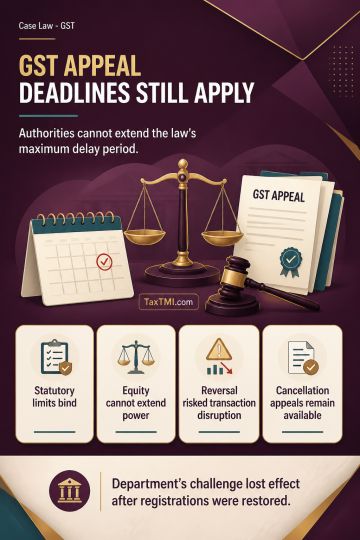
Statutory appellate authorities may condone delay in GST appeals only within the enactment's prescribed outer limit; equitable considerations or High Court directions issued under extraordinary jurisdiction cannot enlarge that power. Where the Department implemented an appellate order by restoring cancelled GST registrations, its subsequent challenge became infructuous because reversal could disrupt intervening transactions and input tax credit without workable consequential relief. Taxpayers retain an independent right to appeal registration cancellation when the common portal prevents a delayed revocation application; failure to seek revocation under Rule 23 does not extinguish that appellate remedy.
Statutory appellate authorities may condone delay in GST appeals only within the enactment's prescribed outer limit; equitable considerations or High Court directions issued under extraordinary jurisdiction cannot enlarge that power. Where the Department implemented an appellate order by restoring cancelled GST registrations, its subsequent challenge became infructuous because reversal could disrupt intervening transactions and input tax credit without workable consequential relief. Taxpayers retain an independent right to appeal registration cancellation when the common portal prevents a delayed revocation application; failure to seek revocation under Rule 23 does not extinguish that appellate remedy.
Note: It is a system-generated summary and is for quick reference only.
 TaxTMI
 TaxTMI

 of 4927