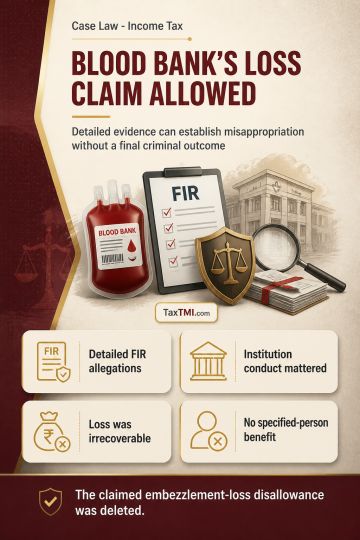
Embezzlement losses in charitable institutions remain allowable when misappropriation is established, irrecoverable, and not a specified-person benefi...
National long-distance undertaking status supports deduction where separately licensed infrastructure, resources, revenue, and expenditure establish c...
Agency reimbursement income follows contractual deposit-liability computation, while pending deposit collections do not constitute deemed-dividend loa...
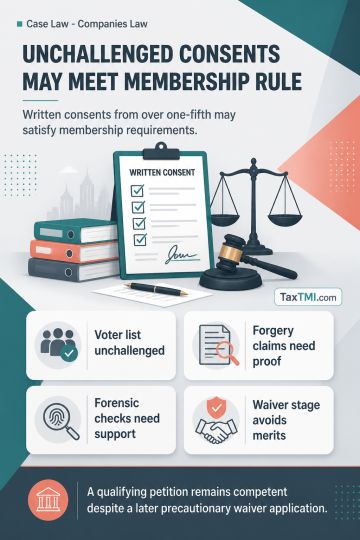
Membership-consent thresholds for oppression petitions are satisfied by unchallenged voter-list consents, while unsupported forgery claims require pro...
Article 227 supervisory intervention in ongoing arbitration is...
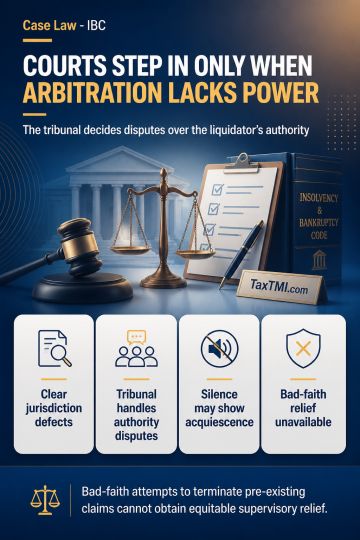
Article 227 review permits intervention in arbitration only for manifest, patent inherent jurisdictional defects, not representational authority disputes.
Contents
Summary
Note
Bookmark
Share
✓ Copied successfully !
Print
Print Options
For full text, please login
Login to TaxTMI
Verification Pending
The Email Id has not been verified. Click on the link we have sent on
Article 227 supervisory intervention in ongoing arbitration is confined to a manifest and patent lack of inherent jurisdiction. Where the arbitration agreement, its invocation for a joint venture, and commencement of the reference are undisputed, a dispute over a liquidator's authority to represent the joint venture and continue proceedings falls within the arbitral tribunal's competence. A joint venture constituent that remains silent after notice of the liquidator's asserted authority may be treated as having acquiesced. Equitable supervisory relief is unavailable where intervention seeks to terminate a pre-existing claim rather than protect the joint venture's interests, particularly where the conduct is in bad faith.
Article 227 supervisory intervention in ongoing arbitration is confined to a manifest and patent lack of inherent jurisdiction. Where the arbitration agreement, its invocation for a joint venture, and commencement of the reference are undisputed, a dispute over a liquidator's authority to represent the joint venture and continue proceedings falls within the arbitral tribunal's competence. A joint venture constituent that remains silent after notice of the liquidator's asserted authority may be treated as having acquiesced. Equitable supervisory relief is unavailable where intervention seeks to terminate a pre-existing claim rather than protect the joint venture's interests, particularly where the conduct is in bad faith.
Note: It is a system-generated summary and is for quick reference only.
 TaxTMI
  TaxTMI
 of 4888