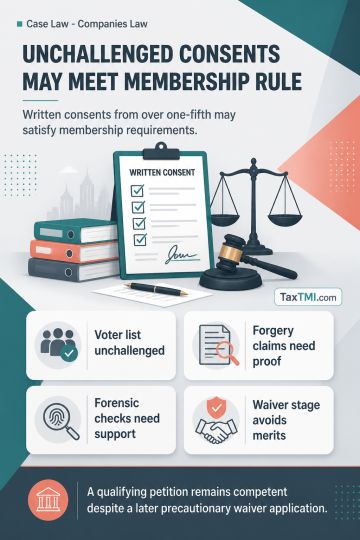
Membership-consent thresholds for oppression petitions are satisfied by unchallenged voter-list consents, while unsupported forgery claims require pro...
Juridical seat versus arbitral venue determines supervisory court jurisdiction, while timely award challenges remain within the prescribed limitation ...
Section 129 transit penalties may operate on a strict-liability basis, but still require proof of a statutory breach attracting the penalty. Where invoices, e-way bills and bilty documents matched the goods, the buyer was identifiable, and historical records supported use of its former address, a repeated consignee-address entry was treated as a bona fide documentary error. In the absence of evidence of a fictitious purchaser, diversion, clandestine unloading, value suppression, or tax evasion, the discrepancy did not establish a substantive transit violation. The transit penalty and consequential recovery were annulled, while tax lawfully payable on the supply remained unaffected.
Section 129 transit penalties may operate on a strict-liability basis, but still require proof of a statutory breach attracting the penalty. Where invoices, e-way bills and bilty documents matched the goods, the buyer was identifiable, and historical records supported use of its former address, a repeated consignee-address entry was treated as a bona fide documentary error. In the absence of evidence of a fictitious purchaser, diversion, clandestine unloading, value suppression, or tax evasion, the discrepancy did not establish a substantive transit violation. The transit penalty and consequential recovery were annulled, while tax lawfully payable on the supply remained unaffected.
Note: It is a system-generated summary and is for quick reference only.
 TaxTMI
  TaxTMI
 of 4891