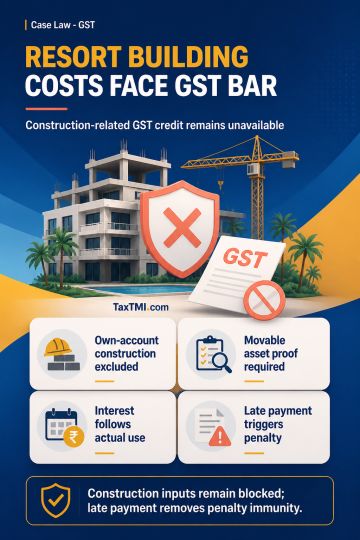
Blocked input tax credit for resort construction remains unavailable; interest follows actual utilisation, while delayed payment attracts statutory pe...
Duplicate PAN allocation requires record verification and deactivation reasons before assessment-related transactions can be attributed to an assessee...
Faceless assessment safeguards require requested personal hearings and adequate final show-cause response time, failing which reassessment is required...
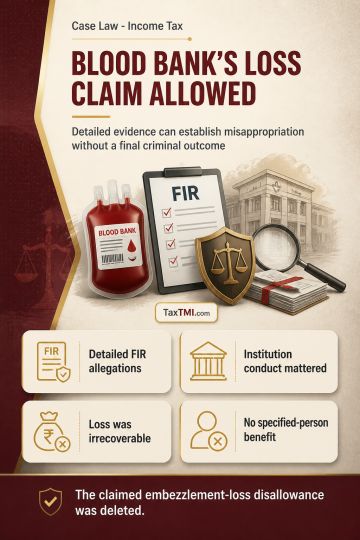
Embezzlement losses in charitable institutions remain allowable when misappropriation is established, irrecoverable, and not a specified-person benefi...
National long-distance undertaking status supports deduction where separately licensed infrastructure, resources, revenue, and expenditure establish c...
Page of 4888
Press 'Enter' after typing page number.
141 to 160 of 97750 Results
❮
❯
❯❯
0 / 200
Expand Note
Add to Folder
No Folders have been created
+
Are you sure you want to delete "My most important" ?
Cross-segment derivatives trading was treated prima facie as manipulative where connected companies moved futures prices through aggressive orders while holding larger, sentimentally opposite options positions and pre-positioned options orders. Artificial futures-price movements enabled favourable options execution, while cancelled, inexecutable futures orders added deceptive order-book depth. Repeated deliberate futures losses coupled with greater options gains were considered inconsistent with legitimate hedging, arbitrage, speculation, or rational profit-maximising conduct. Company directors responsible for business conduct faced a rebuttable presumption of vicarious liability and joint-and-several impounding of gains attributable to their companies. Interim directions restricted market access, preserved assets and gains, and required asset disclosures pending investigation.
Cross-segment derivatives trading was treated prima facie as manipulative where connected companies moved futures prices through aggressive orders while holding larger, sentimentally opposite options positions and pre-positioned options orders. Artificial futures-price movements enabled favourable options execution, while cancelled, inexecutable futures orders added deceptive order-book depth. Repeated deliberate futures losses coupled with greater options gains were considered inconsistent with legitimate hedging, arbitrage, speculation, or rational profit-maximising conduct. Company directors responsible for business conduct faced a rebuttable presumption of vicarious liability and joint-and-several impounding of gains attributable to their companies. Interim directions restricted market access, preserved assets and gains, and required asset disclosures pending investigation.
Note: It is a system-generated summary and is for quick reference only.
 TaxTMI
  TaxTMI
 of 4888