Duplicate PAN allocation requires record verification and deactivation reasons before assessment-related transactions can be attributed to an assessee...
Faceless assessment safeguards require requested personal hearings and adequate final show-cause response time, failing which reassessment is required...
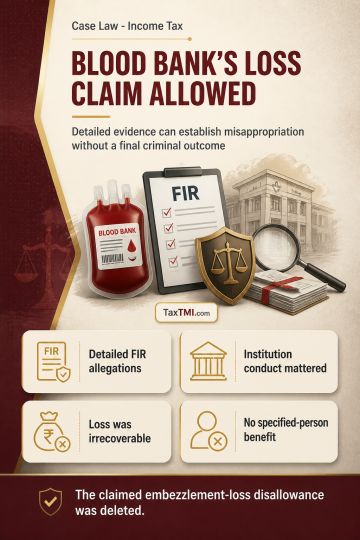
Embezzlement losses in charitable institutions remain allowable when misappropriation is established, irrecoverable, and not a specified-person benefi...
National long-distance undertaking status supports deduction where separately licensed infrastructure, resources, revenue, and expenditure establish c...
Agency reimbursement income follows contractual deposit-liability computation, while pending deposit collections do not constitute deemed-dividend loa...
Page of 4942
Press 'Enter' after typing page number.
1221 to 1240 of 98829 Results
❮
❯
❯❯
0 / 200
Expand Note
Add to Folder
No Folders have been created
+
Are you sure you want to delete "My most important" ?
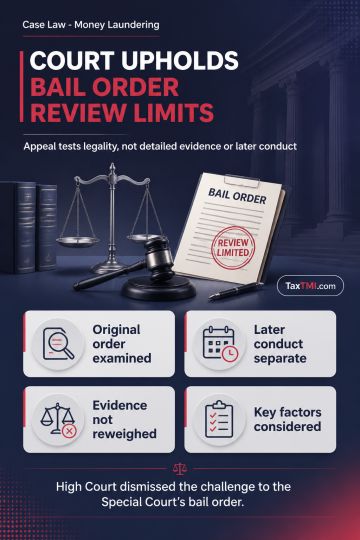
Appellate review of a regular-bail order under the PMLA is confined to whether the grant was illegal, perverse, arbitrary, based on irrelevant material, or made without considering relevant factors; it is distinct from cancellation of bail based on post-bail conduct or supervening circumstances. Bail-stage review cannot involve a detailed adjudication of evidence. The High Court found that the Special Court had considered the alleged proceeds of crime, the trial's non-commencement, and bail conditions, demonstrating application of mind. It dismissed the challenge because the alleged failure to satisfy the statutory twin conditions did not establish grounds to set aside the bail order.
Appellate review of a regular-bail order under the PMLA is confined to whether the grant was illegal, perverse, arbitrary, based on irrelevant material, or made without considering relevant factors; it is distinct from cancellation of bail based on post-bail conduct or supervening circumstances. Bail-stage review cannot involve a detailed adjudication of evidence. The High Court found that the Special Court had considered the alleged proceeds of crime, the trial's non-commencement, and bail conditions, demonstrating application of mind. It dismissed the challenge because the alleged failure to satisfy the statutory twin conditions did not establish grounds to set aside the bail order.
Note: It is a system-generated summary and is for quick reference only.
 TaxTMI
 TaxTMI

 of 4942