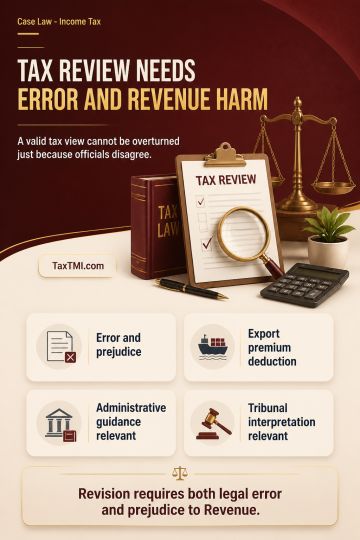
Revisional jurisdiction over export quota premium deductions requires both error and Revenue prejudice; a permissible assessment view cannot be displa...
Final benami adjudication bars contradictory tax-evasion prosecution where settlement findings confirm full disclosure and cooperation without conceal...
Faceless assessment and registration procedures are updated through electronic communication, revised recovery rules, extended deadlines, and replacem...
Risk-based selective vessel boarding requires accurate declarations and preserves master and agent liability where physical inspections are not select...
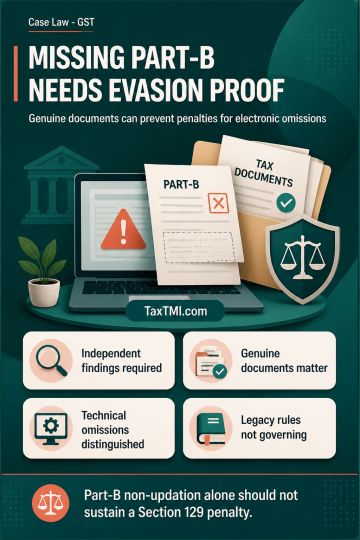
Section 129 penalties for failure to update Part-B of an e-way bill require independent findings of an intent to evade tax where the goods movement is otherwise supported by genuine tax documents. The integrated electronic GST framework distinguishes technical or procedural omissions from active tax-evasion attempts. Where the invoice, Part-A details and underlying transaction transparently establish the movement, non-updation of Part-B alone should not sustain a penalty. Strict-liability principles developed under the legacy manual check-post regime are not treated as governing such electronic GST compliance failures.
Section 129 penalties for failure to update Part-B of an e-way bill require independent findings of an intent to evade tax where the goods movement is otherwise supported by genuine tax documents. The integrated electronic GST framework distinguishes technical or procedural omissions from active tax-evasion attempts. Where the invoice, Part-A details and underlying transaction transparently establish the movement, non-updation of Part-B alone should not sustain a penalty. Strict-liability principles developed under the legacy manual check-post regime are not treated as governing such electronic GST compliance failures.
Note: It is a system-generated summary and is for quick reference only.
 TaxTMI
  TaxTMI
 of 4884