Human-probability test defeats political donation deduction where banking records mask accommodation-entry fund layering and evidence shows non-genuin...
Commercial property status protects capital-gains exemption when residential-house ownership limits are tested, while agricultural-land character gove...
Investigation deposits refunded after failed customs demands fall outside the statutory appellate pre-deposit interest regime and may attract compensa...
Resolution plan finality extinguishes unquantified operational-creditor claims and pending proceedings unless the approved plan expressly preserves th...
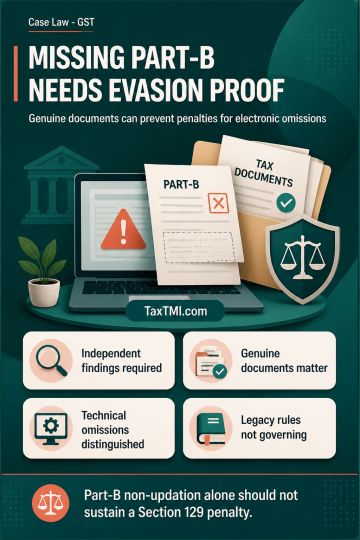
Section 129 penalties for failure to update Part-B of an e-way bill require independent findings of an intent to evade tax where the goods movement is otherwise supported by genuine tax documents. The integrated electronic GST framework distinguishes technical or procedural omissions from active tax-evasion attempts. Where the invoice, Part-A details and underlying transaction transparently establish the movement, non-updation of Part-B alone should not sustain a penalty. Strict-liability principles developed under the legacy manual check-post regime are not treated as governing such electronic GST compliance failures.
Section 129 penalties for failure to update Part-B of an e-way bill require independent findings of an intent to evade tax where the goods movement is otherwise supported by genuine tax documents. The integrated electronic GST framework distinguishes technical or procedural omissions from active tax-evasion attempts. Where the invoice, Part-A details and underlying transaction transparently establish the movement, non-updation of Part-B alone should not sustain a penalty. Strict-liability principles developed under the legacy manual check-post regime are not treated as governing such electronic GST compliance failures.
Note: It is a system-generated summary and is for quick reference only.
 TaxTMI
  TaxTMI
 of 4881