Effective hearing in GST adjudication requires actual opportunity to respond; ineffective service through a former auditor invalidated ex parte procee...
Third-party search material requires special assessment route, rendering general reassessment notices without jurisdiction when it forms the proceedin...
Transfer-pricing adjustments must be confined to international associated-enterprise transactions, while functionally dissimilar comparables remain ex...
Insolvency moratorium bars income-tax revision proceedings against corporate debtors until the moratorium ends, preserving merits for later determinat...
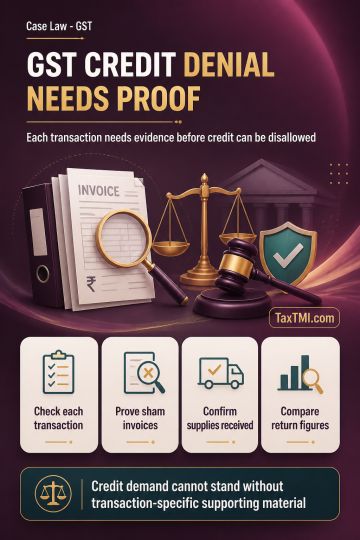
Input tax credit claimed on invoices from a supplier whose registration was retrospectively cancelled requires examination of the facts and evidence for each underlying transaction. Retrospective cancellation alone does not establish credit ineligibility unless specific material shows that invoices were fictitious or sham, or that supplies were not received. Differences between figures in GST returns, standing alone, likewise do not establish an erroneous credit claim. A demand cannot be sustained on a ground materially different from the basis of the original proceedings. Subsequent amendments in GST records may be relevant to determining limited credit eligibility.
Input tax credit claimed on invoices from a supplier whose registration was retrospectively cancelled requires examination of the facts and evidence for each underlying transaction. Retrospective cancellation alone does not establish credit ineligibility unless specific material shows that invoices were fictitious or sham, or that supplies were not received. Differences between figures in GST returns, standing alone, likewise do not establish an erroneous credit claim. A demand cannot be sustained on a ground materially different from the basis of the original proceedings. Subsequent amendments in GST records may be relevant to determining limited credit eligibility.
Note: It is a system-generated summary and is for quick reference only.
 TaxTMI
  TaxTMI
 of 4886