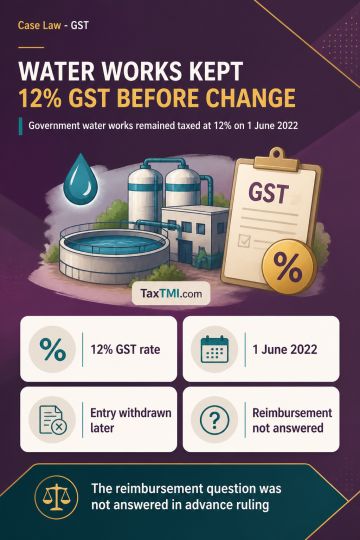
Government water works contract GST concession applied before its withdrawal, while contractual tax reimbursement claims lay outside advance-ruling sc...
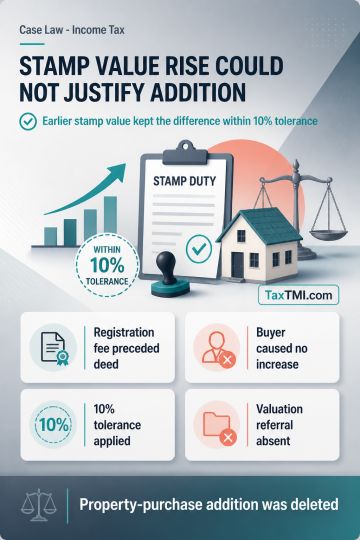
Stamp valuation increases after registration-fee payment led to deletion of property-purchase addition within tolerance and without valuation referral...
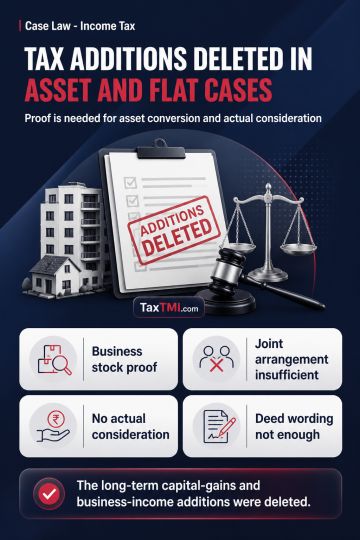
Capital Asset Conversion Requires Proven Business Stock Treatment; Paper Consideration in Spousal Flat Transfers Does Not Create Taxable Business Inco...
Page of 4881
Press 'Enter' after typing page number.
341 to 360 of 97618 Results
❮
❯
❯❯
0 / 200
Expand Note
Add to Folder
No Folders have been created
+
Are you sure you want to delete "My most important" ?
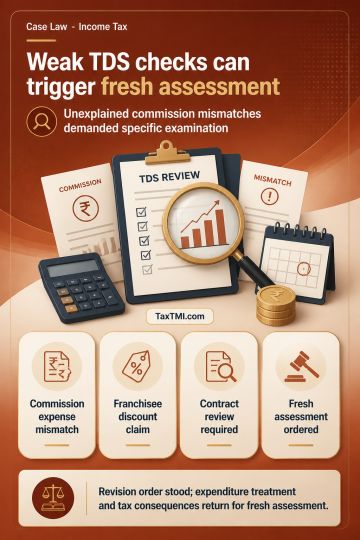
Revisionary jurisdiction for inadequate inquiry into TDS on commission and brokerage expenditure arises where the Assessing Officer merely calls for TDS details without examining a material mismatch between financial-statement expenditure and TDS reporting. A substantial increase in expenditure and a claim that amounts retained by franchisees constituted discounts rather than commission require specific examination of contractual arrangements, accounting treatment and TDS liability. Failure to conduct that inquiry may render an assessment erroneous and prejudicial to Revenue interests, rather than reflecting a prohibited change of opinion. The revisionary order was sustained, leaving the expenditure's nature and tax consequences for fresh assessment after giving the assessee an opportunity to respond.
Revisionary jurisdiction for inadequate inquiry into TDS on commission and brokerage expenditure arises where the Assessing Officer merely calls for TDS details without examining a material mismatch between financial-statement expenditure and TDS reporting. A substantial increase in expenditure and a claim that amounts retained by franchisees constituted discounts rather than commission require specific examination of contractual arrangements, accounting treatment and TDS liability. Failure to conduct that inquiry may render an assessment erroneous and prejudicial to Revenue interests, rather than reflecting a prohibited change of opinion. The revisionary order was sustained, leaving the expenditure's nature and tax consequences for fresh assessment after giving the assessee an opportunity to respond.
Note: It is a system-generated summary and is for quick reference only.
 TaxTMI
  TaxTMI
 of 4881