Internal CUP benchmarking for fixed-rate Masala Bonds prevails over floating external comparables, eliminating the related transfer-pricing adjustment...
Jurisdictional validity of revision notices: incorrect official capacity and mere change of opinion invalidate revision of property income assessments...
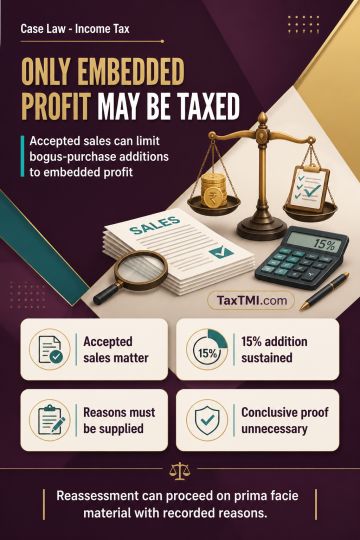
Bogus-purchase additions are limited to embedded profit where corresponding sales are accepted, while accommodation-entry information can support reas...
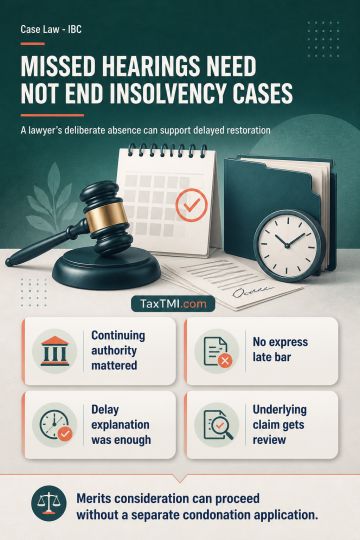
Restoration of an insolvency application dismissed for non-prosecution can be supported by sufficient cause where former counsel deliberately failed to appear or enable substitution despite a continuing vakalatnama; that default should not be attributed to the litigant. Rule 48(2) of the NCLT Rules prescribes a 30-day restoration period but does not expressly prohibit a later recall request. Section 238A applies the Limitation Act, as far as may be, to insolvency proceedings, allowing Section 5 condonation on sufficient cause. Where the restoration request itself explains the delay, a separate condonation application is unnecessary, permitting merits consideration of the underlying claim.
Restoration of an insolvency application dismissed for non-prosecution can be supported by sufficient cause where former counsel deliberately failed to appear or enable substitution despite a continuing vakalatnama; that default should not be attributed to the litigant. Rule 48(2) of the NCLT Rules prescribes a 30-day restoration period but does not expressly prohibit a later recall request. Section 238A applies the Limitation Act, as far as may be, to insolvency proceedings, allowing Section 5 condonation on sufficient cause. Where the restoration request itself explains the delay, a separate condonation application is unnecessary, permitting merits consideration of the underlying claim.
Note: It is a system-generated summary and is for quick reference only.
 TaxTMI
  TaxTMI
 of 4891