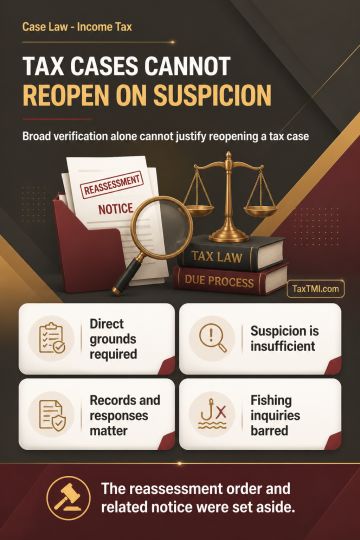
Permanent-establishment reassessment cannot revisit scrutinised disclosures; extended reopening fails without undisclosed material facts and within st...
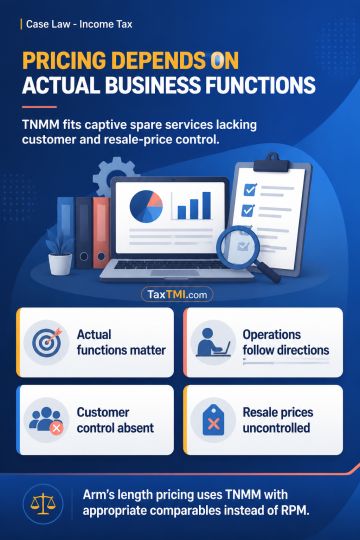
Modified returns after business reorganisation must be assessed within pending proceedings, barring parallel scrutiny and consequential transfer prici...
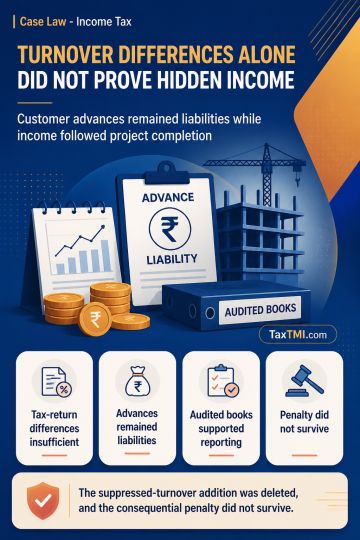
Turnover mismatches under percentage-completion accounting cannot alone establish suppressed income where customer advances remain recorded as liabili...
Page of 4881
Press 'Enter' after typing page number.
541 to 560 of 97618 Results
❮
❯
❯❯
0 / 200
Expand Note
Add to Folder
No Folders have been created
+
Are you sure you want to delete "My most important" ?
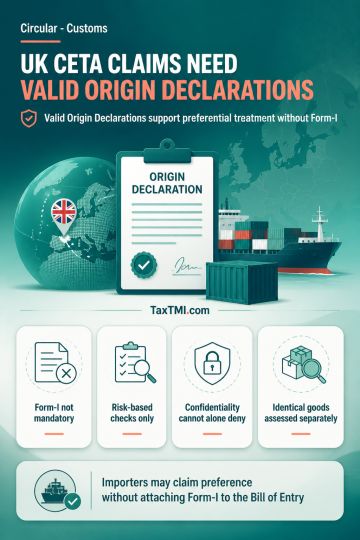
Rules of Origin under a trade agreement prevail over CAROTAR, 2020 where inconsistent. For preferential imports under the India-UK CETA, a valid Origin Declaration from the UK exporter or producer is sufficient proof of origin; Form-I is neither required with the Bill of Entry nor a condition for preferential tariff treatment. Form-I information may be sought only where risk-based origin checks are triggered and the proper officer has reason to believe origin criteria are unmet. Failure to provide exporter or producer confidential information cannot alone deny preference, and insufficient information may be verified through the exporting party's Verification Authority. Earlier adverse origin determinations apply to later imports only when goods are genuinely identical, subject to importer submissions and independent assessment of materially different goods.
Rules of Origin under a trade agreement prevail over CAROTAR, 2020 where inconsistent. For preferential imports under the India-UK CETA, a valid Origin Declaration from the UK exporter or producer is sufficient proof of origin; Form-I is neither required with the Bill of Entry nor a condition for preferential tariff treatment. Form-I information may be sought only where risk-based origin checks are triggered and the proper officer has reason to believe origin criteria are unmet. Failure to provide exporter or producer confidential information cannot alone deny preference, and insufficient information may be verified through the exporting party's Verification Authority. Earlier adverse origin determinations apply to later imports only when goods are genuinely identical, subject to importer submissions and independent assessment of materially different goods.
Note: It is a system-generated summary and is for quick reference only.
 TaxTMI
  TaxTMI
 of 4881