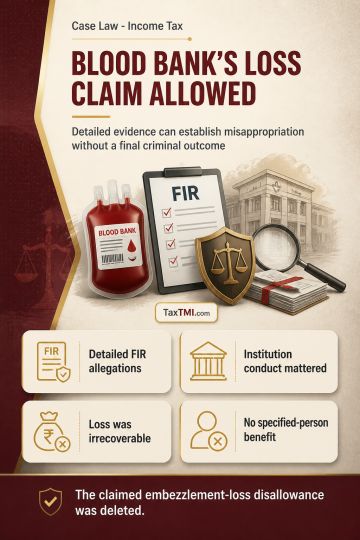
Embezzlement losses in charitable institutions remain allowable when misappropriation is established, irrecoverable, and not a specified-person benefi...
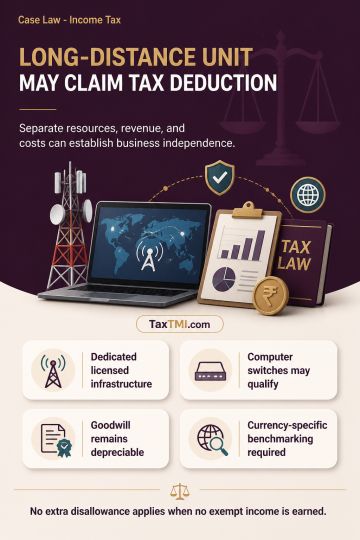
National long-distance undertaking status supports deduction where separately licensed infrastructure, resources, revenue, and expenditure establish c...
Agency reimbursement income follows contractual deposit-liability computation, while pending deposit collections do not constitute deemed-dividend loa...
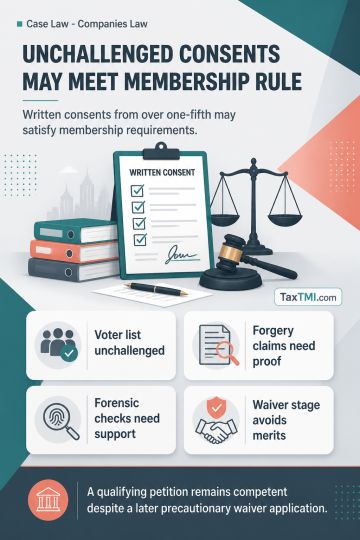
Membership-consent thresholds for oppression petitions are satisfied by unchallenged voter-list consents, while unsupported forgery claims require pro...
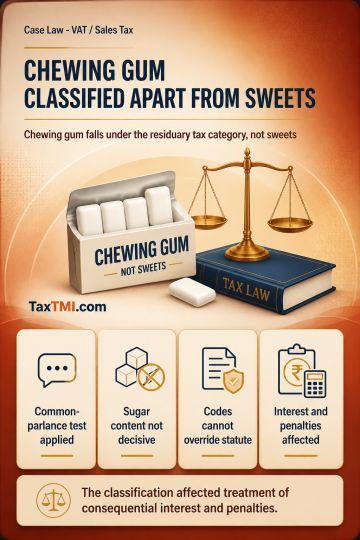
Chewing gum is classified as unclassified goods under residuary Entry 87 of Schedule II to the Gujarat Value Added Tax Act, 2003, rather than as "sweets and sweetmeats" under Entry 74A. Applying the common-parlance test and the Supreme Court position that chewing gum or bubble gum is chewed and discarded rather than eaten, its sugar content does not make it a sweetmeat. Commodity codes used for e-services and prior departmental treatment cannot override statutory classification. As no specific entry covers chewing gum, the residuary entry applies; the contrary classification also affected the treatment of consequential interest and penalties.
Chewing gum is classified as unclassified goods under residuary Entry 87 of Schedule II to the Gujarat Value Added Tax Act, 2003, rather than as "sweets and sweetmeats" under Entry 74A. Applying the common-parlance test and the Supreme Court position that chewing gum or bubble gum is chewed and discarded rather than eaten, its sugar content does not make it a sweetmeat. Commodity codes used for e-services and prior departmental treatment cannot override statutory classification. As no specific entry covers chewing gum, the residuary entry applies; the contrary classification also affected the treatment of consequential interest and penalties.
Note: It is a system-generated summary and is for quick reference only.
 TaxTMI
  TaxTMI
 of 4879