Social forestry expenditure requires activity-based classification, limiting book-profit adjustments and preserving penalty relief where normal additi...
Inaccurate-particulars penalties fail where transfer-pricing documentation shows good faith and due diligence, and underlying capital-gains additions ...
Page of 4886
Press 'Enter' after typing page number.
681 to 700 of 97714 Results
❮
❯
❯❯
0 / 200
Expand Note
Add to Folder
No Folders have been created
+
Are you sure you want to delete "My most important" ?
Appellate enhancement is confined to income sources examined in...
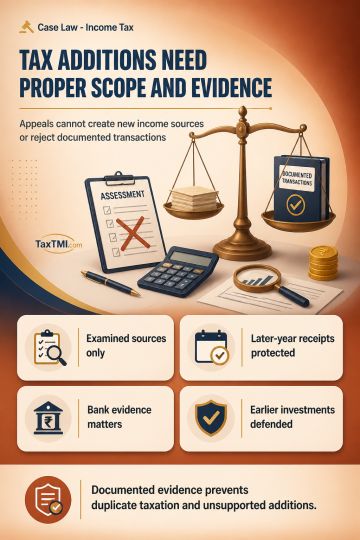
Appellate enhancement limits protect against new income sources, while documented credits and prior-year investments resist unexplained-income additions.
Contents
Summary
Note
Bookmark
Share
✓ Copied successfully !
Print
Print Options
For full text, please login
Login to TaxTMI
Verification Pending
The Email Id has not been verified. Click on the link we have sent on
Appellate enhancement is confined to income sources examined in assessment and cannot introduce sale consideration as a new taxable source where only related expenditure was scrutinised. Advance rental receipts already offered in later years are not taxable again absent accrual in the relevant year, preventing double taxation. Recorded bank credits, loans and advances supported by ledgers, confirmations and banking evidence cannot be treated as unexplained without adverse material. Likewise, no unexplained-investment addition arises for shareholdings acquired in earlier years, while documentary proof of disclosed cash sources and individual-to-HUF transfers shifts the evidentiary burden to the Revenue.
Appellate enhancement is confined to income sources examined in assessment and cannot introduce sale consideration as a new taxable source where only related expenditure was scrutinised. Advance rental receipts already offered in later years are not taxable again absent accrual in the relevant year, preventing double taxation. Recorded bank credits, loans and advances supported by ledgers, confirmations and banking evidence cannot be treated as unexplained without adverse material. Likewise, no unexplained-investment addition arises for shareholdings acquired in earlier years, while documentary proof of disclosed cash sources and individual-to-HUF transfers shifts the evidentiary burden to the Revenue.
Note: It is a system-generated summary and is for quick reference only.
 TaxTMI
  TaxTMI
 of 4886