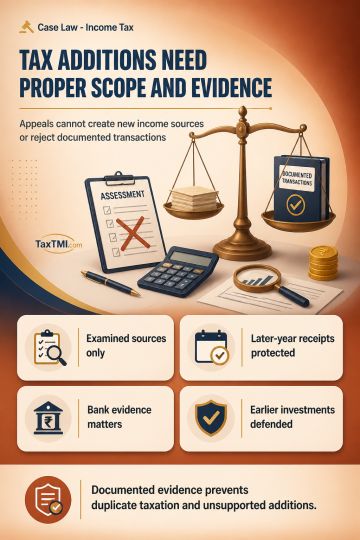
Appellate enhancement limits protect against new income sources, while documented credits and prior-year investments resist unexplained-income additio...
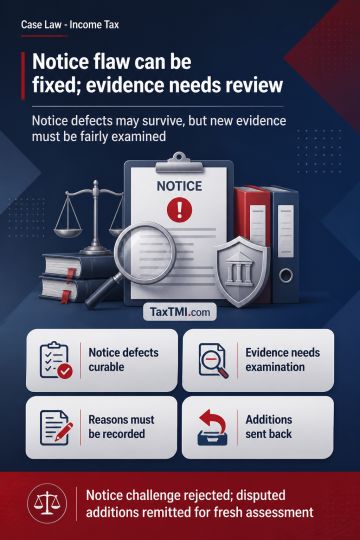
Non-conformity of a scrutiny notice under section 143(2) with the CBDT-prescribed format is treated as a procedural defect curable under section 292B, rather than one invalidating the notice or consequential assessment. In appellate proceedings, material admitted as additional evidence must be made available to the Assessing Officer for examination under Rule 46A. Deletions based on unexamined material, or made without recorded reasons, require reconsideration through a fresh, reasoned assessment after hearing the assessee. The notice challenge was rejected, while disputed additions were remitted for de novo assessment.
Non-conformity of a scrutiny notice under section 143(2) with the CBDT-prescribed format is treated as a procedural defect curable under section 292B, rather than one invalidating the notice or consequential assessment. In appellate proceedings, material admitted as additional evidence must be made available to the Assessing Officer for examination under Rule 46A. Deletions based on unexamined material, or made without recorded reasons, require reconsideration through a fresh, reasoned assessment after hearing the assessee. The notice challenge was rejected, while disputed additions were remitted for de novo assessment.
Note: It is a system-generated summary and is for quick reference only.
 TaxTMI
  TaxTMI
 of 4879