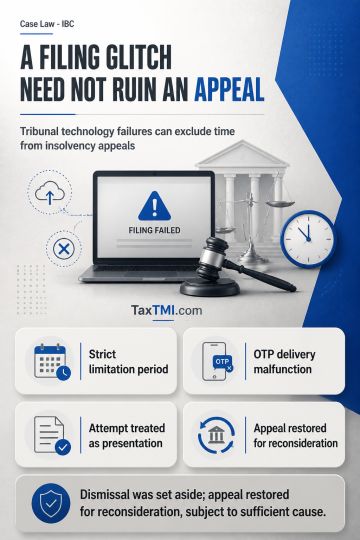
E-filing system failure permits exclusion of affected time in insolvency appeals, preventing tribunal technology defects from defeating timely filings...
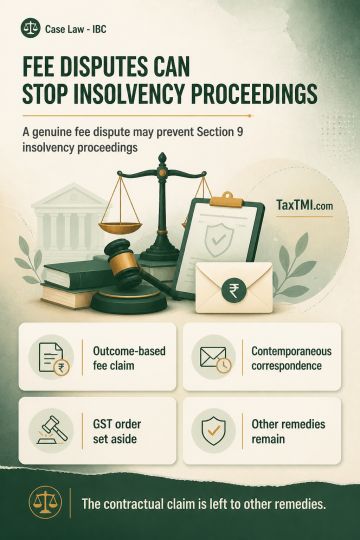
Pre-existing disputes over outcome-based professional fees can bar Section 9 insolvency proceedings where contractual entitlement requires investigati...
Corresponding scheduled offences preserve money-laundering jurisdiction despite repeal of the central corruption provision where conduct remains cover...
Section 271(1)(c) treats concealment of income and furnishing inaccurate particulars as distinct penal defaults, requiring clear identification and proof of the specific charge. Mere non-disclosure does not establish inaccurate particulars unless the return contains incorrect or false details. An explanation offered during assessment, not found false and used to quantify the addition, may support bona fides and prevent application of Explanation 1. Although tax penalties do not require proof of mens rea, an addition alone does not make penalty automatic. On these facts, the absence of a specific default and failure to satisfy Explanation 1 led to deletion of the penalty.
Section 271(1)(c) treats concealment of income and furnishing inaccurate particulars as distinct penal defaults, requiring clear identification and proof of the specific charge. Mere non-disclosure does not establish inaccurate particulars unless the return contains incorrect or false details. An explanation offered during assessment, not found false and used to quantify the addition, may support bona fides and prevent application of Explanation 1. Although tax penalties do not require proof of mens rea, an addition alone does not make penalty automatic. On these facts, the absence of a specific default and failure to satisfy Explanation 1 led to deletion of the penalty.
Note: It is a system-generated summary and is for quick reference only.
 TaxTMI
  TaxTMI
 of 4884