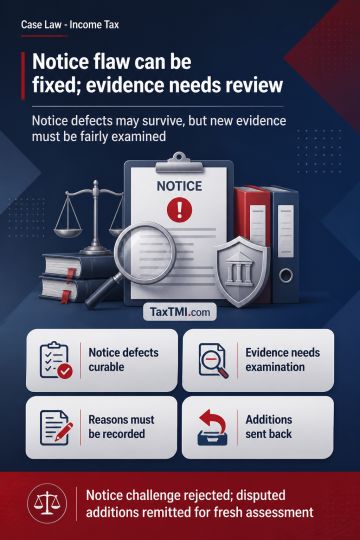
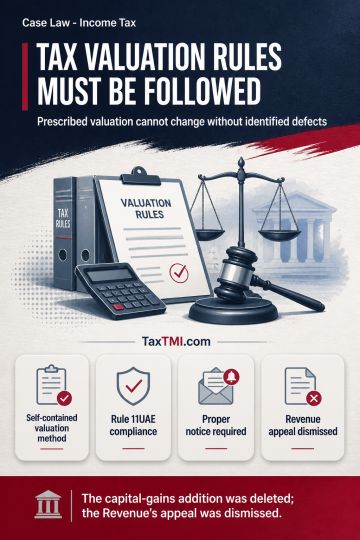
Capital Asset Conversion Requires Proven Business Stock Treatment; Paper Consideration in Spousal Flat Transfers Does Not Create Taxable Business Inco...
Human-probability test defeats political donation deduction where banking records mask accommodation-entry fund layering and evidence shows non-genuin...
Commercial property status protects capital-gains exemption when residential-house ownership limits are tested, while agricultural-land character gove...
Section 271(1)(c) treats concealment of income and furnishing inaccurate particulars as distinct penal defaults, requiring clear identification and proof of the specific charge. Mere non-disclosure does not establish inaccurate particulars unless the return contains incorrect or false details. An explanation offered during assessment, not found false and used to quantify the addition, may support bona fides and prevent application of Explanation 1. Although tax penalties do not require proof of mens rea, an addition alone does not make penalty automatic. On these facts, the absence of a specific default and failure to satisfy Explanation 1 led to deletion of the penalty.
Section 271(1)(c) treats concealment of income and furnishing inaccurate particulars as distinct penal defaults, requiring clear identification and proof of the specific charge. Mere non-disclosure does not establish inaccurate particulars unless the return contains incorrect or false details. An explanation offered during assessment, not found false and used to quantify the addition, may support bona fides and prevent application of Explanation 1. Although tax penalties do not require proof of mens rea, an addition alone does not make penalty automatic. On these facts, the absence of a specific default and failure to satisfy Explanation 1 led to deletion of the penalty.
Note: It is a system-generated summary and is for quick reference only.
 TaxTMI
  TaxTMI
 of 4879