Commodity derivatives position limits adopt revised breach penalties, broad commodity criteria, and client open-position limits based on deliverable s...
Effective hearing in GST adjudication requires actual opportunity to respond; ineffective service through a former auditor invalidated ex parte procee...
Third-party search material requires special assessment route, rendering general reassessment notices without jurisdiction when it forms the proceedin...
Transfer-pricing adjustments must be confined to international associated-enterprise transactions, while functionally dissimilar comparables remain ex...
Insolvency moratorium bars income-tax revision proceedings against corporate debtors until the moratorium ends, preserving merits for later determinat...
Page of 4897
Press 'Enter' after typing page number.
1141 to 1160 of 97923 Results
❮
❯
❯❯
0 / 200
Expand Note
Add to Folder
No Folders have been created
+
Are you sure you want to delete "My most important" ?
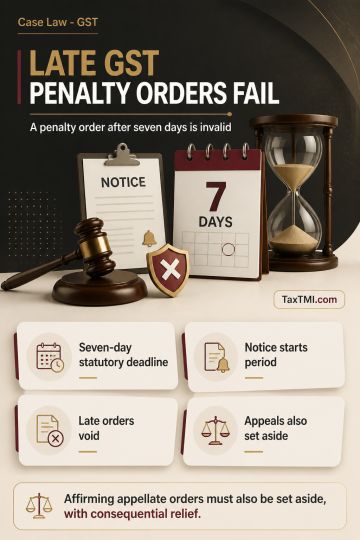
Mandatory seven-day period for passing a detention penalty order after service of notice under section 129(3) is binding because of the term "shall". A penalty order issued after that period violates the statutory time limit and vitiates the detention penalty proceedings. Such an order is void from inception and a nullity; an appellate order affirming it must also be set aside, with consequential relief.
Mandatory seven-day period for passing a detention penalty order after service of notice under section 129(3) is binding because of the term "shall". A penalty order issued after that period violates the statutory time limit and vitiates the detention penalty proceedings. Such an order is void from inception and a nullity; an appellate order affirming it must also be set aside, with consequential relief.
Note: It is a system-generated summary and is for quick reference only.
 TaxTMI
  TaxTMI
 of 4897