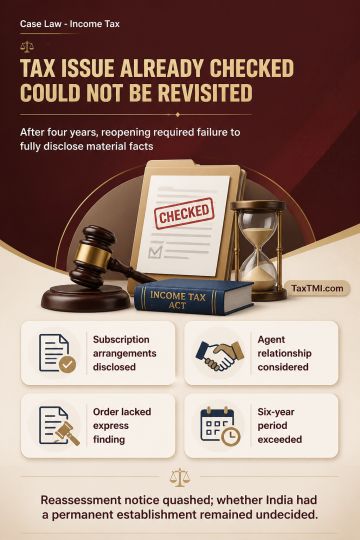
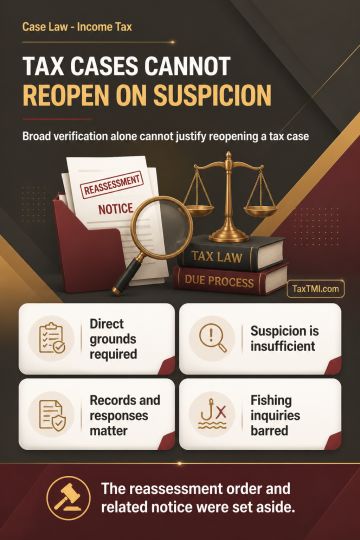
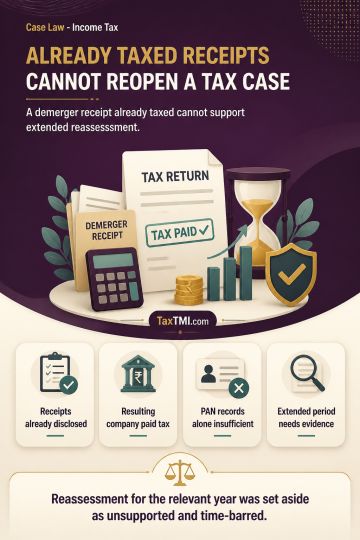
Permanent-establishment reassessment cannot revisit scrutinised disclosures; extended reopening fails without undisclosed material facts and within st...
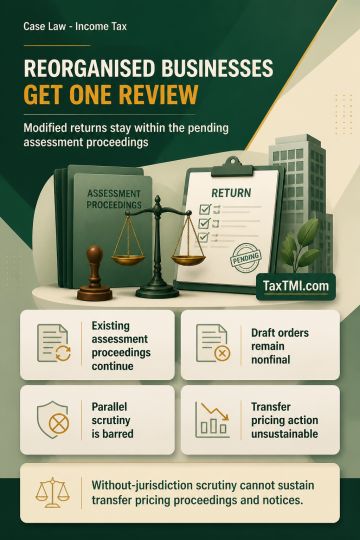
Modified returns after business reorganisation must be assessed within pending proceedings, barring parallel scrutiny and consequential transfer prici...
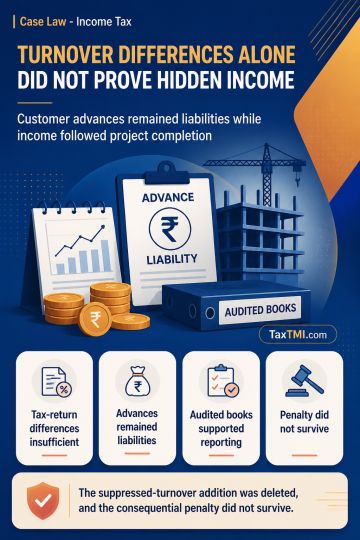
Turnover mismatches under percentage-completion accounting cannot alone establish suppressed income where customer advances remain recorded as liabili...
Page of 4881
Press 'Enter' after typing page number.
541 to 560 of 97618 Results
❮
❯
❯❯
0 / 200
Expand Note
Add to Folder
No Folders have been created
+
Are you sure you want to delete "My most important" ?
COVID-19 limitation exclusion applies to judicial,...
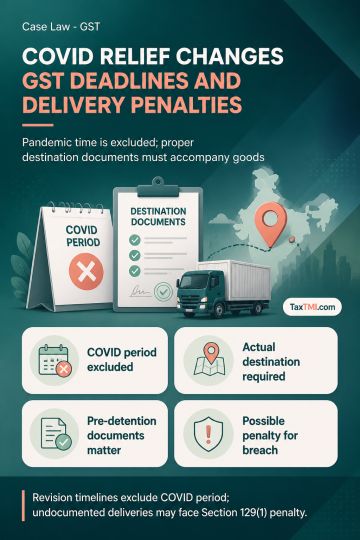
COVID-19 limitation exclusion and destination-specific e-way bills govern revisional timelines and penalties for undocumented third-party plywood deliveries.
Contents
Summary
Note
Bookmark
Share
✓ Copied successfully !
Print
Print Options
For full text, please login
Login to TaxTMI
Verification Pending
The Email Id has not been verified. Click on the link we have sent on
COVID-19 limitation exclusion applies to judicial, quasi-judicial and departmental proceedings, and must be excluded when calculating the period for exercising revisional powers where the statutory period overlaps that exclusion. For transport compliance, an e-way bill and tax invoice must cover the actual movement and destination of goods. Documents issued after detention do not cure the absence of destination-specific documentation at interception, particularly where no evidence supports a claimed technical glitch. Such undocumented third-party unloading may be treated as a wilful contravention intended to evade tax and may attract penalty under Section 129(1).
COVID-19 limitation exclusion applies to judicial, quasi-judicial and departmental proceedings, and must be excluded when calculating the period for exercising revisional powers where the statutory period overlaps that exclusion. For transport compliance, an e-way bill and tax invoice must cover the actual movement and destination of goods. Documents issued after detention do not cure the absence of destination-specific documentation at interception, particularly where no evidence supports a claimed technical glitch. Such undocumented third-party unloading may be treated as a wilful contravention intended to evade tax and may attract penalty under Section 129(1).
Note: It is a system-generated summary and is for quick reference only.
 TaxTMI
  TaxTMI
 of 4881