Section 153C requires person-specific search authority and year-specific incriminating material for unabated assessments while preventing unsupported ...
Equivalent-value attachment can reach pre-existing assets, but jointly owned property remains protected beyond the accused's attributable proceeds of ...
Page of 4891
Press 'Enter' after typing page number.
941 to 960 of 97820 Results
❮
❯
❯❯
0 / 200
Expand Note
Add to Folder
No Folders have been created
+
Are you sure you want to delete "My most important" ?
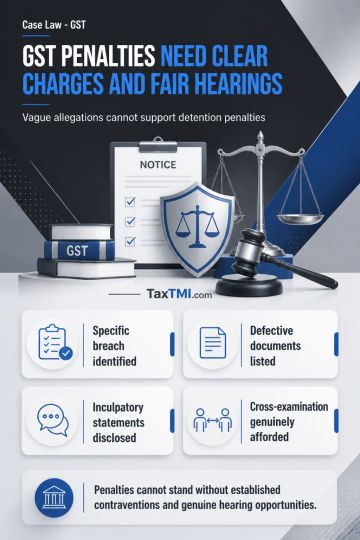
GST detention penalties under section 129 require a pleaded and established contravention of the Act or Rules. A show-cause notice must identify the defective documents and the precise legal provision allegedly breached; a vague allegation of diversion or unloading at an undeclared destination is insufficient. Reliance on inculpatory statements requires their disclosure, and an offered personal hearing and cross-examination opportunity must be genuinely afforded before adjudication. Appellate review must address material natural-justice objections and identify the statutory contravention rather than rely on route or invoicing observations alone.
GST detention penalties under section 129 require a pleaded and established contravention of the Act or Rules. A show-cause notice must identify the defective documents and the precise legal provision allegedly breached; a vague allegation of diversion or unloading at an undeclared destination is insufficient. Reliance on inculpatory statements requires their disclosure, and an offered personal hearing and cross-examination opportunity must be genuinely afforded before adjudication. Appellate review must address material natural-justice objections and identify the statutory contravention rather than rely on route or invoicing observations alone.
Note: It is a system-generated summary and is for quick reference only.
 TaxTMI
  TaxTMI
 of 4891