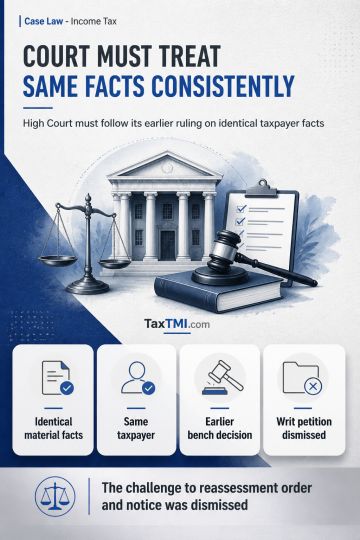
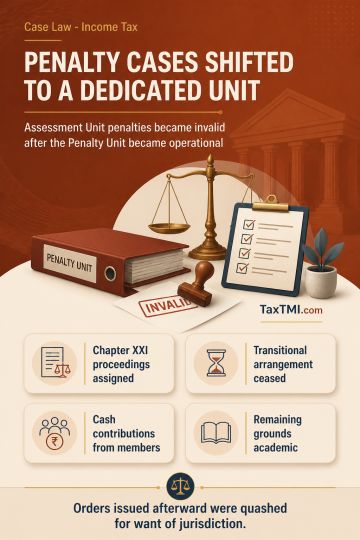
Judicial discipline requires consistent reassessment treatment where identical facts were decided for the same taxpayer in the preceding assessment ye...
Agreement-date stamp valuation requires the same registered property, fixed consideration, and qualifying payment; an unrelated prior booking cannot a...
Page of 4896
Press 'Enter' after typing page number.
261 to 280 of 97907 Results
❮
❯
❯❯
0 / 200
Expand Note
Add to Folder
No Folders have been created
+
Are you sure you want to delete "My most important" ?
Transfer-pricing treatment of intra-group management and...
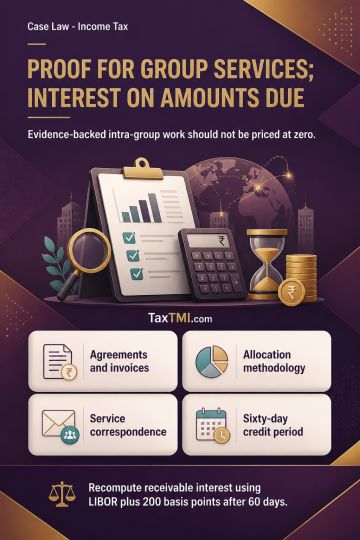
Intra-group service benefit evidence prevents nil pricing, while associated-enterprise receivables require LIBOR-based interest benchmarking after the permitted credit period.
Contents
Summary
Note
Bookmark
Share
✓ Copied successfully !
Print
Print Options
For full text, please login
Login to TaxTMI
Verification Pending
The Email Id has not been verified. Click on the link we have sent on
Transfer-pricing treatment of intra-group management and technical services requires evidence that services were rendered, availed and commensurate with the charge, including agreements, allocation methodology, invoices and correspondence. Commercial expediency remains the taxpayer's business judgment: the TPO cannot replace it or insist on immediate benefits, and an arm's length price should not be fixed at nil where evidence supports the services. For outstanding associated-enterprise receivables, interest is benchmarked at LIBOR plus 200 basis points after a 60-day credit period, requiring recomputation on that basis.
Transfer-pricing treatment of intra-group management and technical services requires evidence that services were rendered, availed and commensurate with the charge, including agreements, allocation methodology, invoices and correspondence. Commercial expediency remains the taxpayer's business judgment: the TPO cannot replace it or insist on immediate benefits, and an arm's length price should not be fixed at nil where evidence supports the services. For outstanding associated-enterprise receivables, interest is benchmarked at LIBOR plus 200 basis points after a 60-day credit period, requiring recomputation on that basis.
Note: It is a system-generated summary and is for quick reference only.
 TaxTMI
  TaxTMI
 of 4896