Pre-existing disputes over outcome-based professional fees can bar Section 9 insolvency proceedings where contractual entitlement requires investigati...
Corresponding scheduled offences preserve money-laundering jurisdiction despite repeal of the central corruption provision where conduct remains cover...
Concurrent anticipatory-bail jurisdiction permits applications before either forum, while secured evidence may negate custodial interrogation in GST e...
Page of 4881
Press 'Enter' after typing page number.
621 to 640 of 97618 Results
❮
❯
❯❯
0 / 200
Expand Note
Add to Folder
No Folders have been created
+
Are you sure you want to delete "My most important" ?
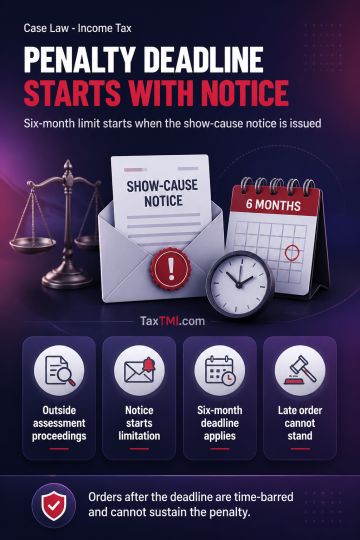
Penalty proceedings under section 271D that are not initiated during an assessment or other proceeding fall outside the first alternative limitation period in section 275(1)(c). In that situation, the show-cause notice constitutes the latest point at which action to impose the penalty is regarded as initiated. The penalty order must therefore be made within six months from the end of the month in which that notice is issued. An order made after that deadline is time-barred and cannot sustain the penalty.
Penalty proceedings under section 271D that are not initiated during an assessment or other proceeding fall outside the first alternative limitation period in section 275(1)(c). In that situation, the show-cause notice constitutes the latest point at which action to impose the penalty is regarded as initiated. The penalty order must therefore be made within six months from the end of the month in which that notice is issued. An order made after that deadline is time-barred and cannot sustain the penalty.
Note: It is a system-generated summary and is for quick reference only.
 TaxTMI
  TaxTMI
 of 4881