Effective hearing in GST adjudication requires actual opportunity to respond; ineffective service through a former auditor invalidated ex parte procee...
Third-party search material requires special assessment route, rendering general reassessment notices without jurisdiction when it forms the proceedin...
Transfer-pricing adjustments must be confined to international associated-enterprise transactions, while functionally dissimilar comparables remain ex...
Insolvency moratorium bars income-tax revision proceedings against corporate debtors until the moratorium ends, preserving merits for later determinat...
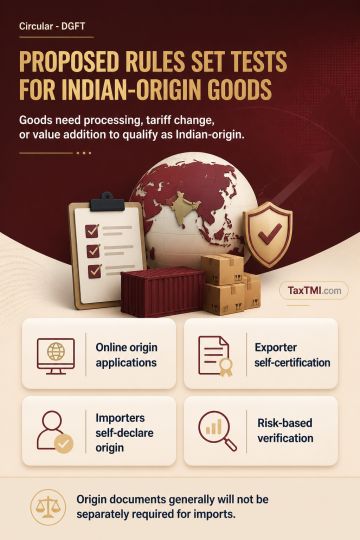
Proposed non-preferential Rules of Origin would require exported goods using imported inputs to undergo processing beyond specified minimal operations before being treated as Indian-origin. Exporters would apply online for non-preferential Certificates of Origin, while manufacturer exporters holding Status Holder recognition could self-certify qualifying goods. Back-to-back certificates could support re-exports, trans-shipment and merchanting trade for foreign-origin goods. For imports, agricultural goods would generally be origin-determined by wholly obtained or produced status, subject to a de-minimis tolerance, while other goods would require either a change in tariff heading or prescribed value addition. Importers would self-declare origin; separate origin documents would generally not be required, with risk-based verification permitted.
Proposed non-preferential Rules of Origin would require exported goods using imported inputs to undergo processing beyond specified minimal operations before being treated as Indian-origin. Exporters would apply online for non-preferential Certificates of Origin, while manufacturer exporters holding Status Holder recognition could self-certify qualifying goods. Back-to-back certificates could support re-exports, trans-shipment and merchanting trade for foreign-origin goods. For imports, agricultural goods would generally be origin-determined by wholly obtained or produced status, subject to a de-minimis tolerance, while other goods would require either a change in tariff heading or prescribed value addition. Importers would self-declare origin; separate origin documents would generally not be required, with risk-based verification permitted.
Note: It is a system-generated summary and is for quick reference only.
 TaxTMI
  TaxTMI
 of 4881