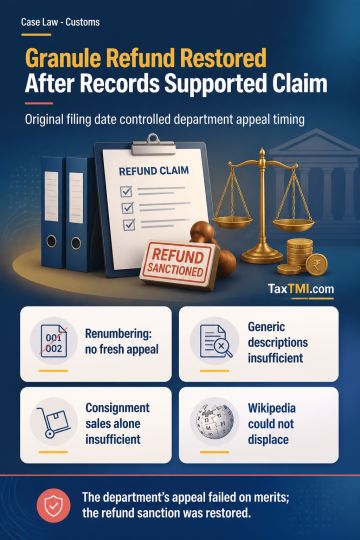
Departmental appeal limitation after call-book recall preserves original filing, while documented correlation supports SAD refund on imported granules...
Income-tax prosecution fails when appellate remand removes its factual foundation; directors require company arraignment for vicarious criminal liabil...
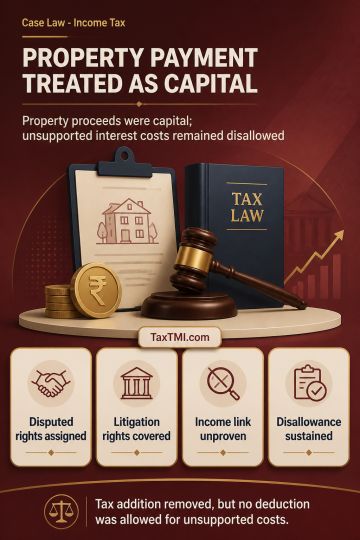
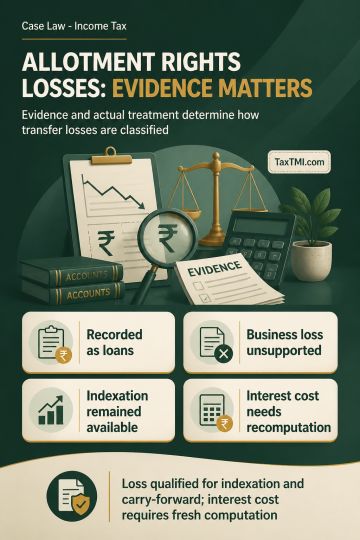
Capital character of assignment consideration prevents taxation as residuary income, while unsupported interest-related expenditure remains non-deduct...
Make-available condition shields regional support-service receipts from Indian taxation where no independent capability or permanent establishment exi...
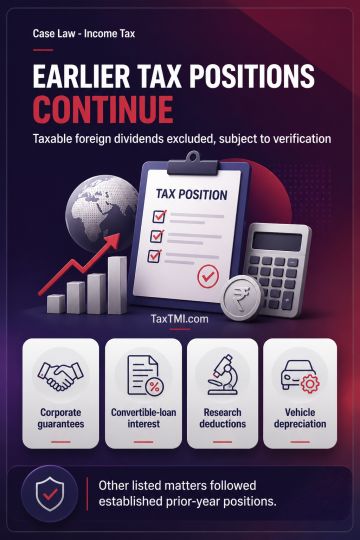
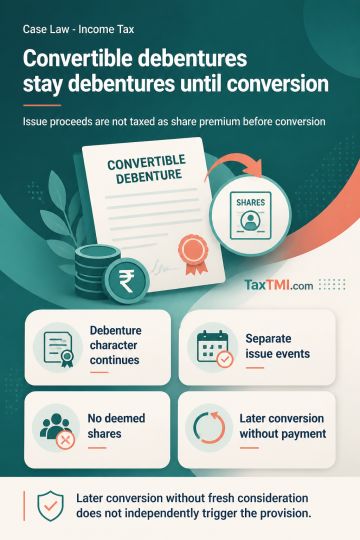
Transfer-pricing treatment of corporate guarantees and convertible loans followed prior-year consistency, with taxable foreign dividends excluded from...
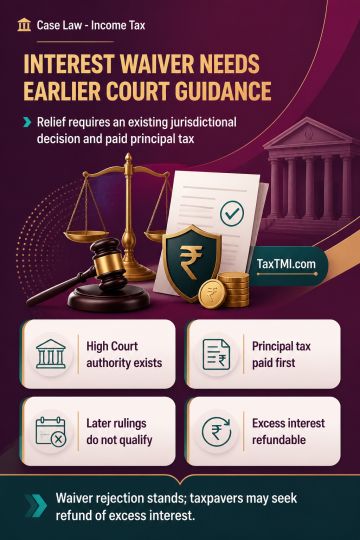
Clause 2(c) of the 2006 interest waiver/reduction scheme requires non-payment of tax to result from a jurisdictional High Court ruling that governed the taxpayer when advance tax was paid or the return was filed. A later ruling does not satisfy that condition, and waiver also requires prior payment of the principal income-tax demand. Challenges to the underlying interest liability cannot be pursued in proceedings confined to a waiver application. Interest under section 220(2) arises only after default in paying a demand served under section 156 within the prescribed period. Waiver rejection was sustained, while taxpayers may seek refund of excess section 220(2) interest if charged from the return-filing date.
Clause 2(c) of the 2006 interest waiver/reduction scheme requires non-payment of tax to result from a jurisdictional High Court ruling that governed the taxpayer when advance tax was paid or the return was filed. A later ruling does not satisfy that condition, and waiver also requires prior payment of the principal income-tax demand. Challenges to the underlying interest liability cannot be pursued in proceedings confined to a waiver application. Interest under section 220(2) arises only after default in paying a demand served under section 156 within the prescribed period. Waiver rejection was sustained, while taxpayers may seek refund of excess section 220(2) interest if charged from the return-filing date.
Note: It is a system-generated summary and is for quick reference only.
 TaxTMI
  TaxTMI
 of 4883