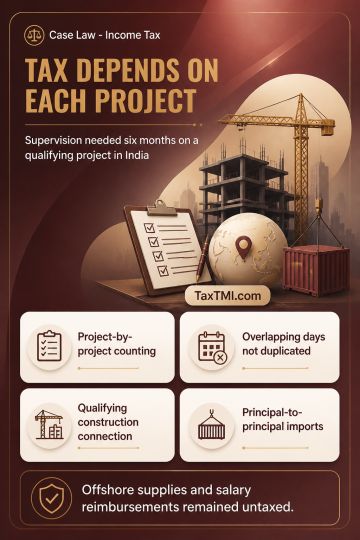
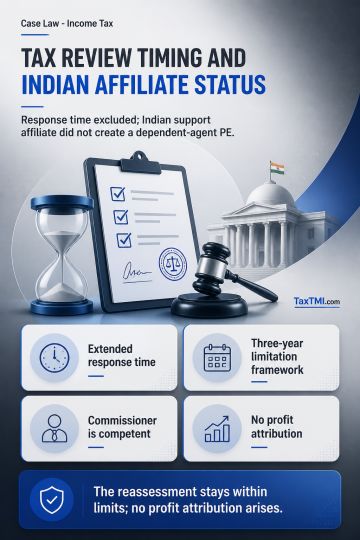
Supervisory permanent establishment requires project-wise duration and qualifying construction nexus; offshore supplies and salary reimbursements rema...
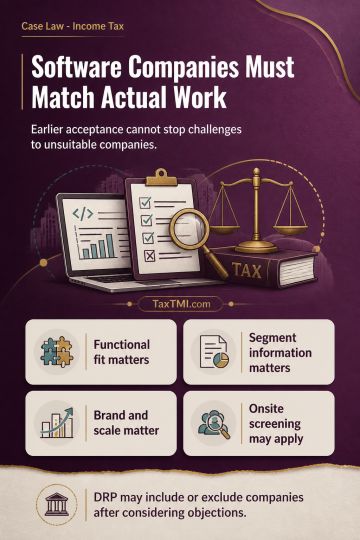
Transfer-pricing comparability permits fresh objections and filters where software service comparables are functionally unsuitable for arm's-length pr...
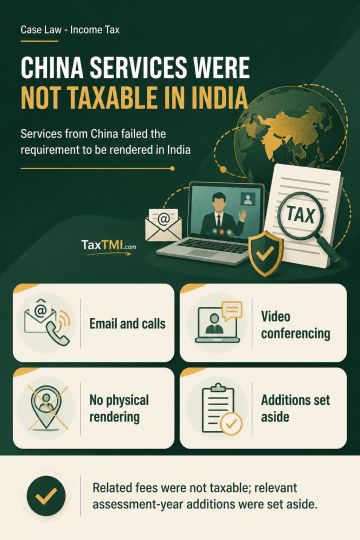
Territorial rendering requirement excludes China-based management and consultancy services from fees for technical services under the India-China DTAA...
Delayed-payment surcharge for late electricity-bill payment does...
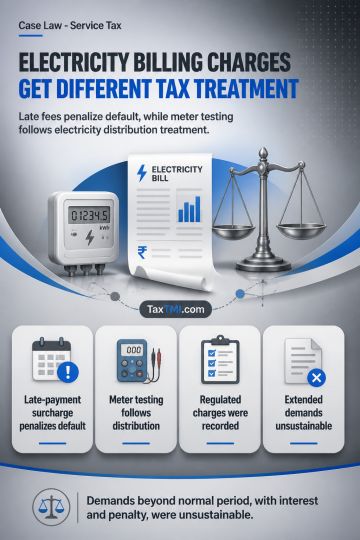
Delayed-payment surcharge is not taxable tolerance consideration where it penalises default, while meter testing follows electricity distribution treatment.
Contents
Summary
Note
Bookmark
Share
✓ Copied successfully !
Print
Print Options
For full text, please login
Login to TaxTMI
Verification Pending
The Email Id has not been verified. Click on the link we have sent on
Delayed-payment surcharge for late electricity-bill payment does not constitute consideration for tolerating an act under Section 66E(e) where it secures timely payment, discourages default and lacks an express or implied reciprocal agreement to accept delay. Meter-testing charges are ancillary to statutory electricity distribution, inseparable from consumption measurement and billing, and therefore take the negative-list treatment of the principal distribution service despite separate pricing. Extended limitation requires positive evidence of fraud, collusion, wilful misstatement, suppression or contravention intended to evade tax; publicly regulated, recorded charges previously examined by the tax authorities do not establish deliberate suppression. Consequently, demands beyond the normal period, with related interest and penalty, were unsustainable.
Delayed-payment surcharge for late electricity-bill payment does not constitute consideration for tolerating an act under Section 66E(e) where it secures timely payment, discourages default and lacks an express or implied reciprocal agreement to accept delay. Meter-testing charges are ancillary to statutory electricity distribution, inseparable from consumption measurement and billing, and therefore take the negative-list treatment of the principal distribution service despite separate pricing. Extended limitation requires positive evidence of fraud, collusion, wilful misstatement, suppression or contravention intended to evade tax; publicly regulated, recorded charges previously examined by the tax authorities do not establish deliberate suppression. Consequently, demands beyond the normal period, with related interest and penalty, were unsustainable.
Note: It is a system-generated summary and is for quick reference only.
 TaxTMI
  TaxTMI
 of 4894