Income-tax prosecution fails when appellate remand removes its factual foundation; directors require company arraignment for vicarious criminal liabil...
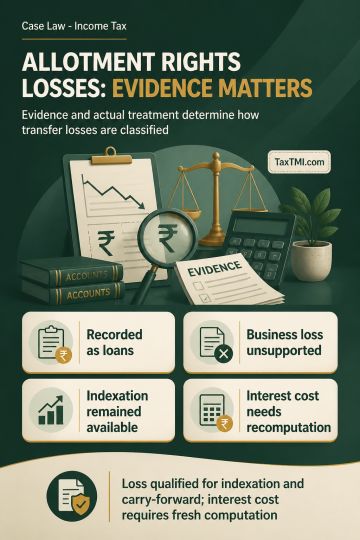
Capital character of assignment consideration prevents taxation as residuary income, while unsupported interest-related expenditure remains non-deduct...
Make-available condition shields regional support-service receipts from Indian taxation where no independent capability or permanent establishment exi...
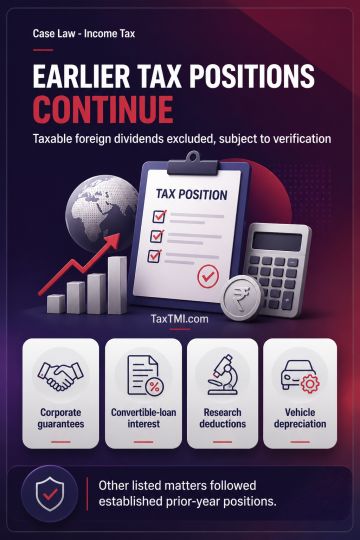
Transfer-pricing treatment of corporate guarantees and convertible loans followed prior-year consistency, with taxable foreign dividends excluded from...
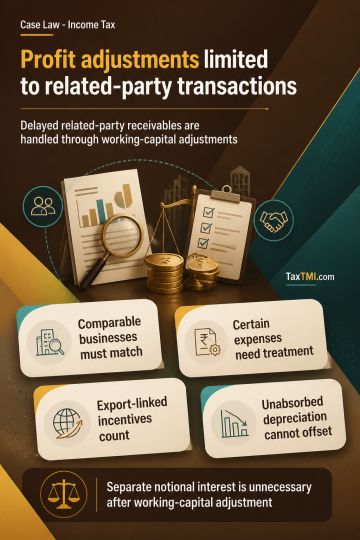
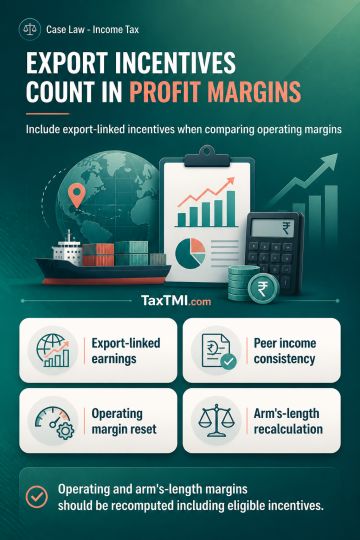
Transfer-pricing benchmarking confines adjustments to associated-enterprise transactions and integrates delayed receivables through TNMM working-capit...
Medical relief status protects government-contracted mobile healthcare from commercial classification, while provisional registration cancellation req...
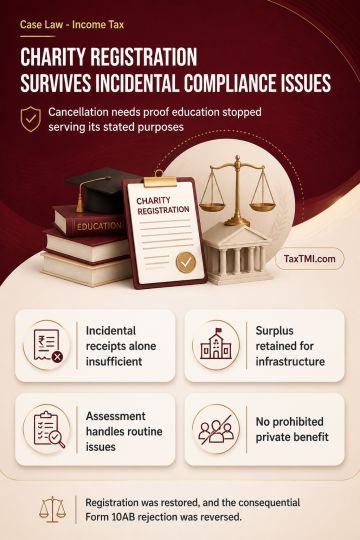
Charitable registration cancellation requires proof that educational activities abandoned their objects; incidental receipts and retained surplus are ...
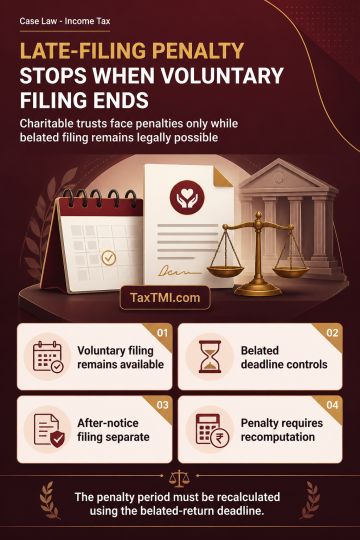
Penalty for a charitable trust's failure to file a return under section 139(4A) should run only while voluntary filing remains legally available under section 139(4). Once the belated-return period expires, the trust has no statutory right to file a valid return voluntarily; a return filed after notice under section 148 follows an independent mechanism. Treating the default as continuing after voluntary compliance becomes impossible would require performance of an impossibility. Accordingly, penalty under section 272A(2)(e) is to be recomputed by limiting the default period to the last date for filing a belated return under section 139(4).
Penalty for a charitable trust's failure to file a return under section 139(4A) should run only while voluntary filing remains legally available under section 139(4). Once the belated-return period expires, the trust has no statutory right to file a valid return voluntarily; a return filed after notice under section 148 follows an independent mechanism. Treating the default as continuing after voluntary compliance becomes impossible would require performance of an impossibility. Accordingly, penalty under section 272A(2)(e) is to be recomputed by limiting the default period to the last date for filing a belated return under section 139(4).
Note: It is a system-generated summary and is for quick reference only.
 TaxTMI
  TaxTMI
 of 4884