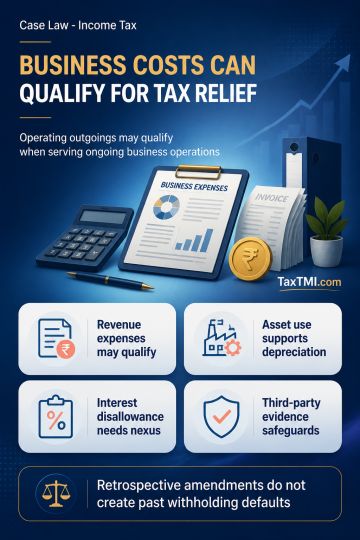
Business expenditure and depreciation rules allow operational outgoings while limiting disallowances for personal elements and unsupported third-party...
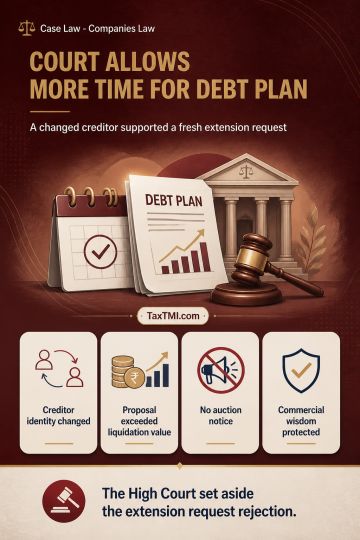
Compromise-and-arrangement extensions may accommodate debt assignment where creditor commercial judgment supports value maximisation and avoids proced...
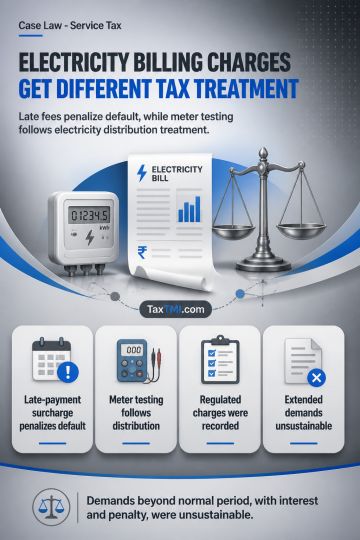
Delayed-payment surcharge is not taxable tolerance consideration where it penalises default, while meter testing follows electricity distribution trea...
Sufficient cause for delayed revenue income-tax appeals requires bona fides, due diligence and a credible explanation; otherwise limitation bars appea...
Inverted-duty-structure refunds remain available for unchanged-rate apparel supplies despite trader status and require tax-period-specific computation...
Page of 4881
Press 'Enter' after typing page number.
781 to 800 of 97618 Results
❮
❯
❯❯
0 / 200
Expand Note
Add to Folder
No Folders have been created
+
Are you sure you want to delete "My most important" ?
Gold imported outside Reserve Bank of India-authorised bulk-import channels or the passenger-import regime under the Baggage Rules is prohibited goods under the Customs Act, 1962. The definition extends to goods restricted under any law in force and is not limited to prohibitions expressly notified under the Customs Act. Consequently, penalties applicable to improper importation of prohibited goods apply. A penalty order is not jurisdictionally invalid merely because it cites an incorrect provision or does not specify the relevant clause, provided the adjudicating authority had substantive power and its reasoned order identifies the goods as prohibited.
Gold imported outside Reserve Bank of India-authorised bulk-import channels or the passenger-import regime under the Baggage Rules is prohibited goods under the Customs Act, 1962. The definition extends to goods restricted under any law in force and is not limited to prohibitions expressly notified under the Customs Act. Consequently, penalties applicable to improper importation of prohibited goods apply. A penalty order is not jurisdictionally invalid merely because it cites an incorrect provision or does not specify the relevant clause, provided the adjudicating authority had substantive power and its reasoned order identifies the goods as prohibited.
Note: It is a system-generated summary and is for quick reference only.
 TaxTMI
  TaxTMI
 of 4881