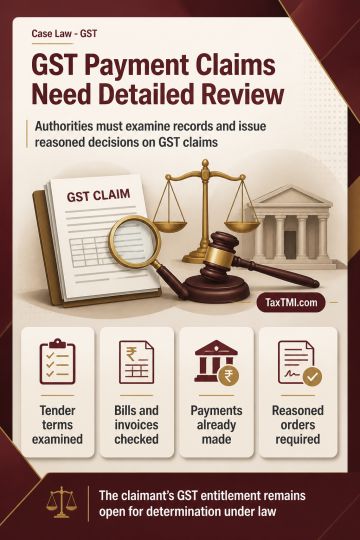
GST payment representations require record-based, reasoned decisions while substantive entitlement remains open for determination by competent authori...
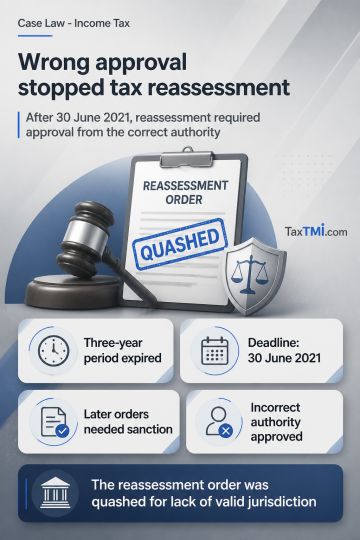
Reassessment sanction under extended limitation required approval from the competent specified authority, invalidating proceedings approved by an inco...
Internal CUP benchmarking for fixed-rate Masala Bonds prevails over floating external comparables, eliminating the related transfer-pricing adjustment...
Jurisdictional validity of revision notices: incorrect official capacity and mere change of opinion invalidate revision of property income assessments...
Page of 4892
Press 'Enter' after typing page number.
1201 to 1220 of 97832 Results
❮
❯
❯❯
0 / 200
Expand Note
Add to Folder
No Folders have been created
+
Are you sure you want to delete "My most important" ?
Income-tax prosecution for false verification or wilful...
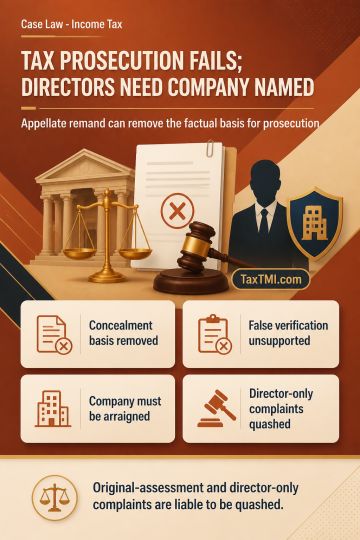
Income-tax prosecution fails when appellate remand removes its factual foundation; directors require company arraignment for vicarious criminal liability.
Contents
Summary
Note
Bookmark
Share
✓ Copied successfully !
Print
Print Options
For full text, please login
Login to TaxTMI
Verification Pending
The Email Id has not been verified. Click on the link we have sent on
Income-tax prosecution for false verification or wilful non-production of accounts cannot continue where a merits-based appellate remand removes the factual foundation of concealment, falsity or wilful default underlying the original assessment. Complaints founded on that original assessment are consequently unsustainable and liable to be quashed. Directors may be prosecuted under a vicarious-liability provision only when the company is arraigned as an accused. A complaint against the company and directors may be maintainable where their respective roles are alleged, but separate complaints against directors alone for the company's offence are unsustainable and liable to be quashed.
Income-tax prosecution for false verification or wilful non-production of accounts cannot continue where a merits-based appellate remand removes the factual foundation of concealment, falsity or wilful default underlying the original assessment. Complaints founded on that original assessment are consequently unsustainable and liable to be quashed. Directors may be prosecuted under a vicarious-liability provision only when the company is arraigned as an accused. A complaint against the company and directors may be maintainable where their respective roles are alleged, but separate complaints against directors alone for the company's offence are unsustainable and liable to be quashed.
Note: It is a system-generated summary and is for quick reference only.
 TaxTMI
  TaxTMI
 of 4892