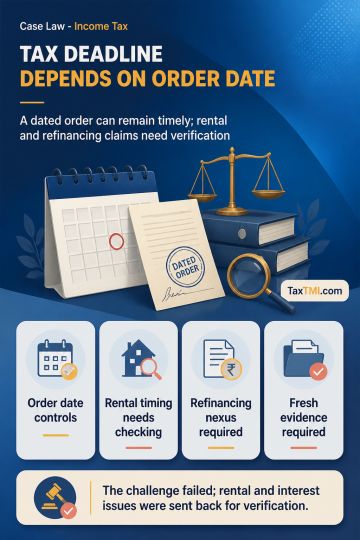
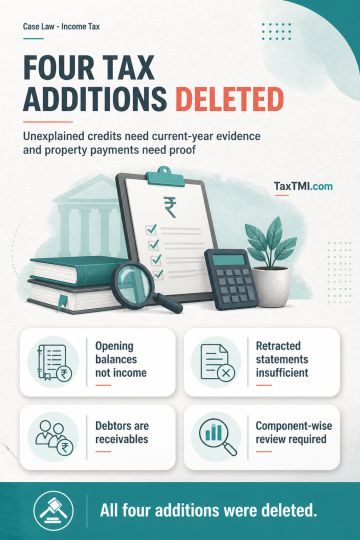
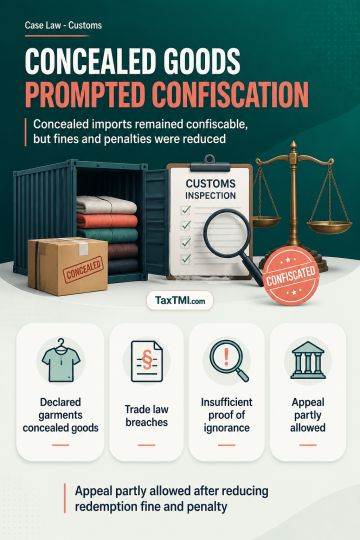
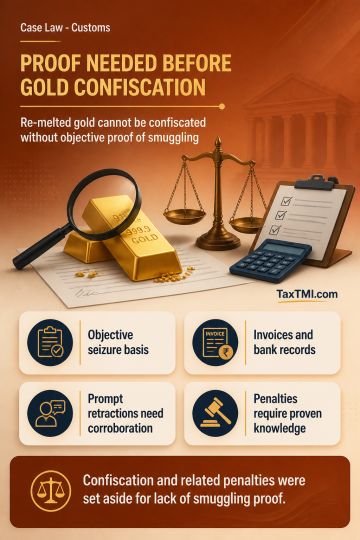
Business expenditure and depreciation rules allow operational outgoings while limiting disallowances for personal elements and unsupported third-party...
Compromise-and-arrangement extensions may accommodate debt assignment where creditor commercial judgment supports value maximisation and avoids proced...
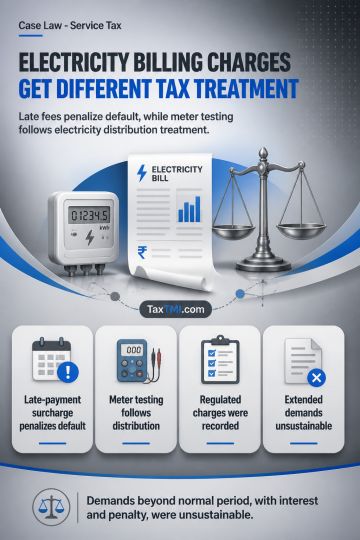
Delayed-payment surcharge is not taxable tolerance consideration where it penalises default, while meter testing follows electricity distribution trea...
Sufficient cause for delayed revenue income-tax appeals requires bona fides, due diligence and a credible explanation; otherwise limitation bars appea...
Inverted-duty-structure refunds remain available for unchanged-rate apparel supplies despite trader status and require tax-period-specific computation...
Page of 4881
Press 'Enter' after typing page number.
781 to 800 of 97618 Results
❮
❯
❯❯
0 / 200
Expand Note
Add to Folder
No Folders have been created
+
Are you sure you want to delete "My most important" ?
Income-tax prosecution for false verification or wilful...
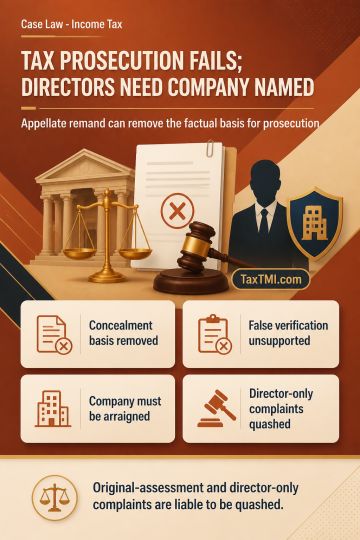
Income-tax prosecution fails when appellate remand removes its factual foundation; directors require company arraignment for vicarious criminal liability.
Contents
Summary
Note
Bookmark
Share
✓ Copied successfully !
Print
Print Options
For full text, please login
Login to TaxTMI
Verification Pending
The Email Id has not been verified. Click on the link we have sent on
Income-tax prosecution for false verification or wilful non-production of accounts cannot continue where a merits-based appellate remand removes the factual foundation of concealment, falsity or wilful default underlying the original assessment. Complaints founded on that original assessment are consequently unsustainable and liable to be quashed. Directors may be prosecuted under a vicarious-liability provision only when the company is arraigned as an accused. A complaint against the company and directors may be maintainable where their respective roles are alleged, but separate complaints against directors alone for the company's offence are unsustainable and liable to be quashed.
Income-tax prosecution for false verification or wilful non-production of accounts cannot continue where a merits-based appellate remand removes the factual foundation of concealment, falsity or wilful default underlying the original assessment. Complaints founded on that original assessment are consequently unsustainable and liable to be quashed. Directors may be prosecuted under a vicarious-liability provision only when the company is arraigned as an accused. A complaint against the company and directors may be maintainable where their respective roles are alleged, but separate complaints against directors alone for the company's offence are unsustainable and liable to be quashed.
Note: It is a system-generated summary and is for quick reference only.
 TaxTMI
  TaxTMI
 of 4881