Effective hearing in GST adjudication requires actual opportunity to respond; ineffective service through a former auditor invalidated ex parte procee...
Third-party search material requires special assessment route, rendering general reassessment notices without jurisdiction when it forms the proceedin...
Transfer-pricing adjustments must be confined to international associated-enterprise transactions, while functionally dissimilar comparables remain ex...
Insolvency moratorium bars income-tax revision proceedings against corporate debtors until the moratorium ends, preserving merits for later determinat...
Medical relief includes mobile healthcare services delivered to...
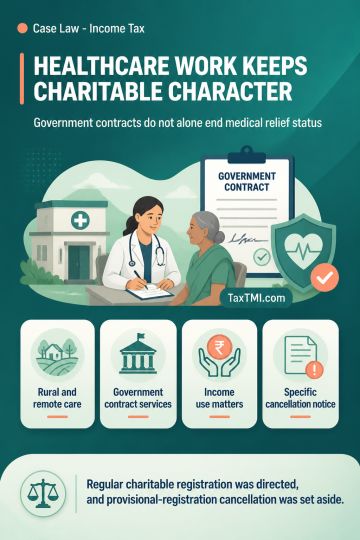
Medical relief status protects government-contracted mobile healthcare from commercial classification, while provisional registration cancellation requires specific notice.
Contents
Summary
Note
Bookmark
Share
✓ Copied successfully !
Print
Print Options
For full text, please login
Login to TaxTMI
Verification Pending
The Email Id has not been verified. Click on the link we have sent on
Medical relief includes mobile healthcare services delivered to rural and remote populations under Government contracts where the objects remain exclusively charitable and prohibit commercial operation. Contractual receipts, tax deduction at source and surplus generation do not alone convert such activities into business; the decisive considerations are the institution's purpose and deployment of income. Regular charitable registration cannot be refused merely because beneficiary records are held by the Government or payments are made to related persons, absent proof that payments were excessive or unreasonable for services rendered. Cancellation of provisional registration requires specific notice of the statutory ground and an effective opportunity to respond. Regular registration was directed, and the provisional-registration cancellation was set aside.
Medical relief includes mobile healthcare services delivered to rural and remote populations under Government contracts where the objects remain exclusively charitable and prohibit commercial operation. Contractual receipts, tax deduction at source and surplus generation do not alone convert such activities into business; the decisive considerations are the institution's purpose and deployment of income. Regular charitable registration cannot be refused merely because beneficiary records are held by the Government or payments are made to related persons, absent proof that payments were excessive or unreasonable for services rendered. Cancellation of provisional registration requires specific notice of the statutory ground and an effective opportunity to respond. Regular registration was directed, and the provisional-registration cancellation was set aside.
Note: It is a system-generated summary and is for quick reference only.
 TaxTMI
  TaxTMI
 of 4881