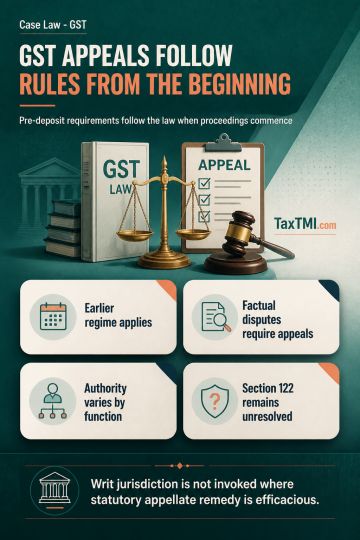
GST payment representations require record-based, reasoned decisions while substantive entitlement remains open for determination by competent authori...
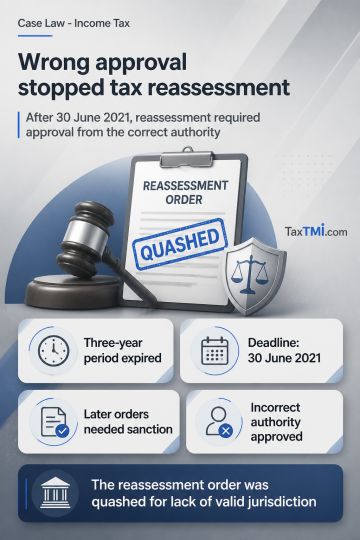
Reassessment sanction under extended limitation required approval from the competent specified authority, invalidating proceedings approved by an inco...
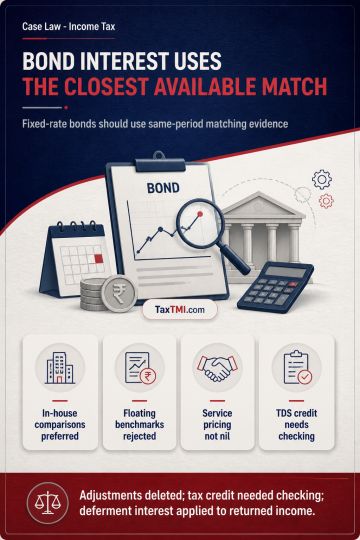
Internal CUP benchmarking for fixed-rate Masala Bonds prevails over floating external comparables, eliminating the related transfer-pricing adjustment...
Page of 4881
Press 'Enter' after typing page number.
981 to 1000 of 97618 Results
❮
❯
❯❯
0 / 200
Expand Note
Add to Folder
No Folders have been created
+
Are you sure you want to delete "My most important" ?
Section 60(2) of the Insolvency and Bankruptcy Code requires an...
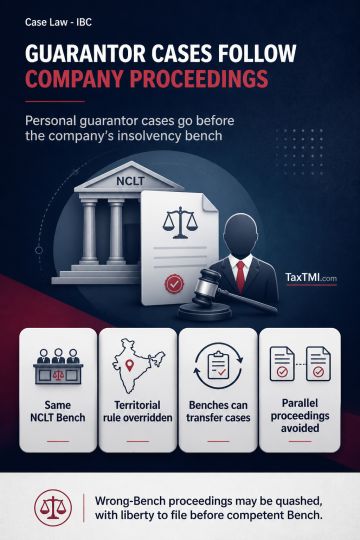
Personal guarantor insolvency jurisdiction follows the corporate debtor's CIRP Bench, enabling inter-territorial transfer and preventing parallel proceedings.
Contents
Summary
Note
Bookmark
Share
✓ Copied successfully !
Print
Print Options
For full text, please login
Login to TaxTMI
Verification Pending
The Email Id has not been verified. Click on the link we have sent on
Section 60(2) of the Insolvency and Bankruptcy Code requires an insolvency application against a personal guarantor to be filed before the same NCLT Bench where the corporate debtor's CIRP or liquidation is pending, overriding the territorial criterion in Section 60(1). This alignment supports consolidated proceedings, consistency and avoidance of conflicting outcomes. Rule 16(d) of the NCLT Rules permits the President to transfer such proceedings between Benches when necessary to implement Section 60(2); the power is not limited to Benches within one territorial location. Proceedings filed before a Bench lacking this jurisdiction may be quashed, with liberty to file before the competent Bench.
Section 60(2) of the Insolvency and Bankruptcy Code requires an insolvency application against a personal guarantor to be filed before the same NCLT Bench where the corporate debtor's CIRP or liquidation is pending, overriding the territorial criterion in Section 60(1). This alignment supports consolidated proceedings, consistency and avoidance of conflicting outcomes. Rule 16(d) of the NCLT Rules permits the President to transfer such proceedings between Benches when necessary to implement Section 60(2); the power is not limited to Benches within one territorial location. Proceedings filed before a Bench lacking this jurisdiction may be quashed, with liberty to file before the competent Bench.
Note: It is a system-generated summary and is for quick reference only.
 TaxTMI
  TaxTMI
 of 4881