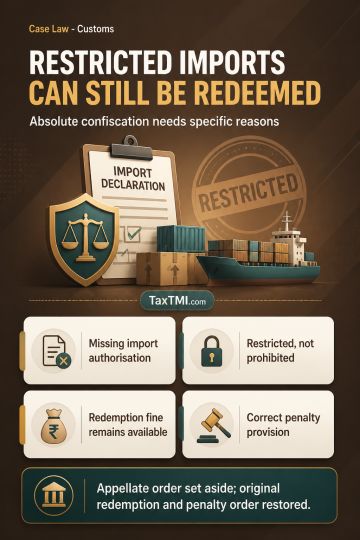
Restricted second-hand goods remain redeemable when absolute confiscation lacks specific reasons, and penalties must follow the applicable import prov...
Alternate statutory remedy governs GST assessment challenge, with statutory appeal preserved and limitation objection barred for the permitted filing ...
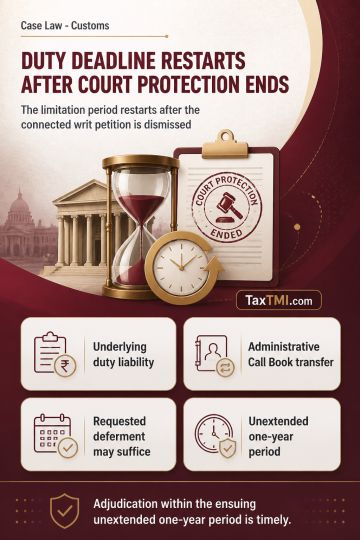
Section 28(9A) of the Customs Act suspends the adjudication limitation period while a specified circumstance prevents determination of duty liability, with the statutory period recommencing when that circumstance ceases. Transfer of a matter to the Call Book is an administrative consequence of such deferment and does not independently create the exclusion period. Where noticees seek deferment because a connected writ petition and interim protection affect the underlying duty liability, those circumstances are directly relevant to non-determination. Noticees' own request for deferment may substantially satisfy the communication requirement. The limitation period consequently runs from dismissal of the connected writ petition, and adjudication within the ensuing unextended one-year period is timely.
Section 28(9A) of the Customs Act suspends the adjudication limitation period while a specified circumstance prevents determination of duty liability, with the statutory period recommencing when that circumstance ceases. Transfer of a matter to the Call Book is an administrative consequence of such deferment and does not independently create the exclusion period. Where noticees seek deferment because a connected writ petition and interim protection affect the underlying duty liability, those circumstances are directly relevant to non-determination. Noticees' own request for deferment may substantially satisfy the communication requirement. The limitation period consequently runs from dismissal of the connected writ petition, and adjudication within the ensuing unextended one-year period is timely.
Note: It is a system-generated summary and is for quick reference only.
 TaxTMI
  TaxTMI
 of 4883