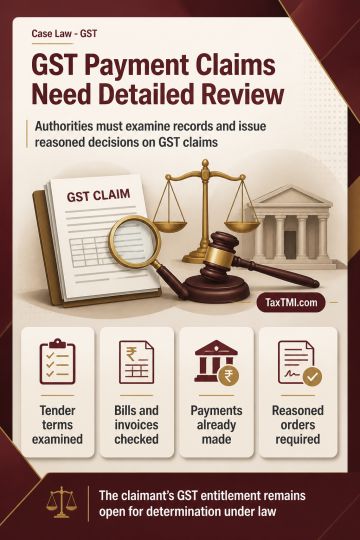
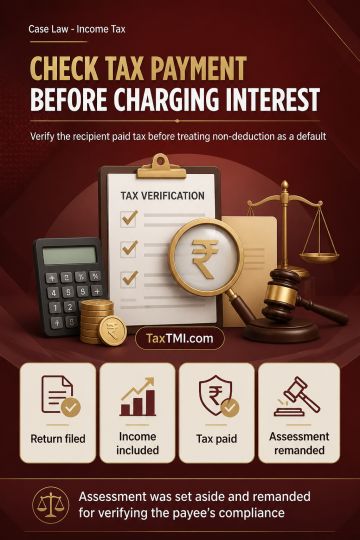
GST payment representations require record-based, reasoned decisions while substantive entitlement remains open for determination by competent authori...
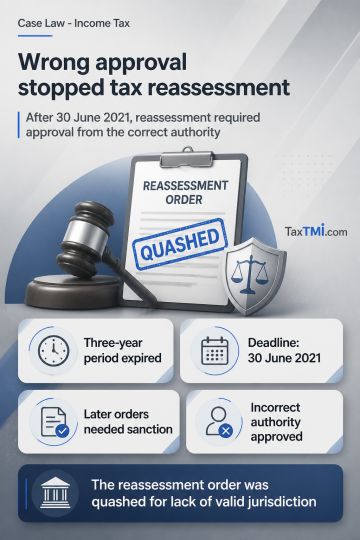
Reassessment sanction under extended limitation required approval from the competent specified authority, invalidating proceedings approved by an inco...
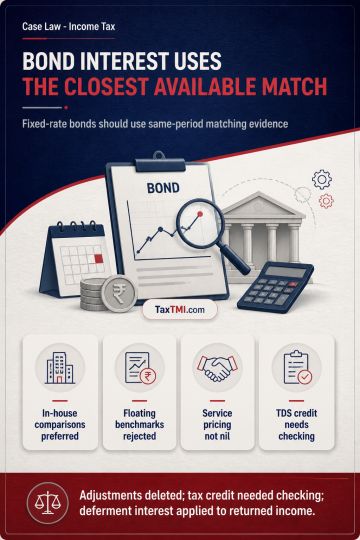
Internal CUP benchmarking for fixed-rate Masala Bonds prevails over floating external comparables, eliminating the related transfer-pricing adjustment...
Page of 4881
Press 'Enter' after typing page number.
981 to 1000 of 97618 Results
❮
❯
❯❯
0 / 200
Expand Note
Add to Folder
No Folders have been created
+
Are you sure you want to delete "My most important" ?
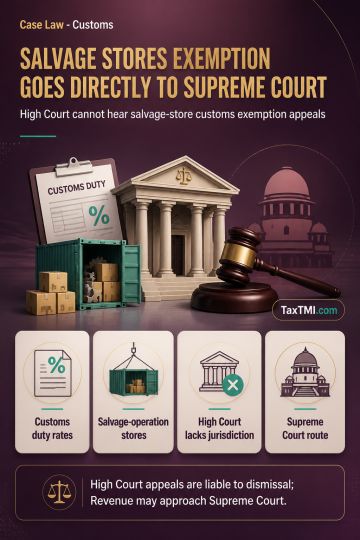
Sections 130 and 130E of the Customs Act exclude High Court appellate jurisdiction over questions relating to the rate of customs duty, including peripheral issues affecting assessment. Entitlement to customs-duty exemption for stores imported for vessel-salvage operations bears on the rate of duty and has wider application; it must therefore be challenged directly before the Supreme Court under Section 130E. Appeals raising that exemption issue are not maintainable before the High Court and are liable to be dismissed for want of jurisdiction, with the Revenue free to approach the Supreme Court.
Sections 130 and 130E of the Customs Act exclude High Court appellate jurisdiction over questions relating to the rate of customs duty, including peripheral issues affecting assessment. Entitlement to customs-duty exemption for stores imported for vessel-salvage operations bears on the rate of duty and has wider application; it must therefore be challenged directly before the Supreme Court under Section 130E. Appeals raising that exemption issue are not maintainable before the High Court and are liable to be dismissed for want of jurisdiction, with the Revenue free to approach the Supreme Court.
Note: It is a system-generated summary and is for quick reference only.
 TaxTMI
  TaxTMI
 of 4881